
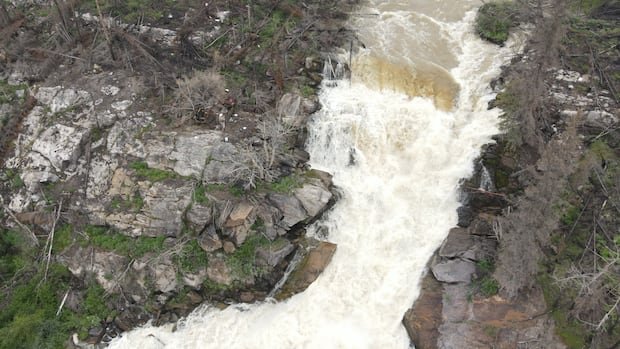

Two scientists have conducted a fresh assessment of a secluded waterfall, indicating that the little-explored falls in the rugged boreal shield of northern Manitoba may be the tallest in the province. Alexander Martin and Lukas Olson utilized digital photogrammetry to measure Kapakaytay Falls on the Odei River, determining a height of 16 meters, slightly surpassing the 14-meter height of Kwasitchewan Falls near Thompson, which is widely regarded as Manitoba’s tallest waterfall. Olson, a PhD candidate at the University of British Columbia specializing in photogrammetry, expressed confidence in the accuracy of their measurement, within a margin of one meter.
Although Kapakaytay Falls was previously measured by the federal government decades ago and recorded at 58 feet (approximately 17 meters) on topographical maps, this information was not widely disseminated. Martin, a Winnipeg resident and ecology PhD student at the University of Oxford, highlighted the lack of widespread awareness regarding the height of the falls, prompting their investigation to ascertain if it indeed holds the title of Manitoba’s tallest waterfall. Situated on the Odei River, approximately 40 kilometers northwest of Thompson and 690 kilometers north of Winnipeg, the falls presented a significant challenge to reach due to their remote location within wildfire-affected forests and the treacherous river terrain, necessitating expertise in whitewater navigation and backcountry skills.
Undertaking a strenuous 105-kilometer roundtrip journey in July, Olson and Martin, with the assistance of local guides, finally laid eyes on the majestic waterfall after days of paddling through rapids and logjams. Overwhelmed by the sheer size and power of the falls upon their arrival, Martin described the experience as breathtaking, while Olson expressed relief at reaching the destination after enduring physical challenges throughout the expedition. The researchers, inspired by a previous visit to the falls by Winnipeg’s Garrett Fache in 2019, meticulously captured over 1,000 two-dimensional images using a drone for digital photogrammetry analysis, corroborating their findings with laser measurements of surrounding trees and natural features.
Their analysis indicated that Kapakaytay Falls may stand at approximately 16 meters, potentially surpassing the heights of Pisew Falls and Kwasitchewan Falls, which measure 13 meters and 14 meters, respectively. Olson and Martin are now focused on publishing their research and anticipate that their documentation of the falls will facilitate future studies of this remote site. Reflecting on the significance of their expedition, Martin emphasized the ongoing opportunities for exploration and documentation even in a world where much of the globe has been mapped.