
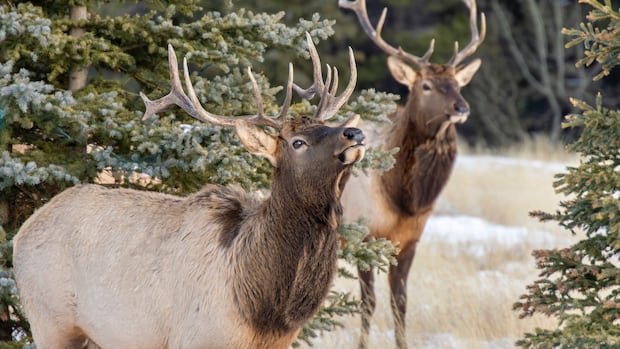

Amidst vibrant orange larch trees, a distinct call reverberates through the Bow Valley. The autumn rut is in full swing, with male ungulates vying for mating privileges across North America. This competition includes elk, commonly spotted in various parts of Alberta. During this season, it is not unusual to witness and hear bull elk attempting to establish their dominance in the Canadian Rockies.
While the iconic bugle call may evoke a similar chilling effect on human ears continent-wide, research conducted in the United States suggests that elk in different regions may actually be using distinct dialects to communicate. Dr. Jennifer Clarke, a biology professor at the University of La Verne in California, shared her findings after studying elk populations in Colorado, Pennsylvania, and Wyoming.
According to Clarke, these three elk populations have been isolated for significant periods, leading to the development of unique communication traits similar to how human populations evolve distinct languages when isolated. The bugling by bull elks serves as a signal of aggression, indicating readiness to confront other males.
Clarke’s study revealed that elk bugles also convey information about the age and size of the elk, with younger bulls emitting “squeaky” calls compared to the more robust calls of dominant mature males. The reasons behind the regional dialect variations among elk remain uncertain, although initial hypotheses linking the dialects to habitat differences were not supported by the data.
The study anticipated that elk in Pennsylvania, dwelling in dense forests, would produce lower-pitched calls to aid in sound transmission, while those in Wyoming and Colorado, inhabiting more open landscapes, would have distinct calls. Surprisingly, all three populations exhibited highly unique bugle calls, indicating that habitat alone did not drive the dialect differences.
Clarke suggested that genetic factors or learning processes might contribute to these dialect variations, emphasizing the need for further research to fully understand this phenomenon. The low genetic diversity in the Pennsylvania elk population was noted to result in more uniform calls compared to the more diverse calls in Colorado and Wyoming populations.
As for Canadian elk, Clarke acknowledged the lack of information on whether they exhibit similar dialect variations. With the elk rut occurring in the region, caution is advised due to the heightened aggressiveness and unpredictability of bull elk during this period. Studies have shown that elk are involved in a majority of aggressive wildlife encounters in Canadian national parks, emphasizing the need for vigilance and maintaining safe distances around these animals.
Nick de Ruyter, program director of the BioSphere Institute’s WildSmart program, highlighted the need to give elk ample space, especially during the rut, as they can react aggressively to perceived threats. It is crucial for individuals to respect wildlife boundaries, refrain from approaching elk too closely, and follow safety guidelines while enjoying outdoor activities in elk habitats.