
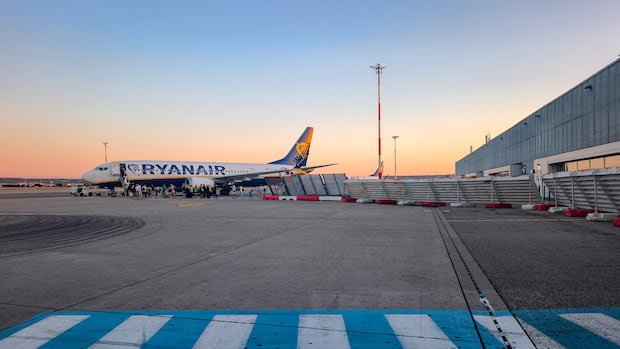

A Ryanair aircraft experienced a terrifying incident last month when a broken engine part shattered a window shortly after takeoff in Greece. The man sitting near the damaged window was almost sucked out before other passengers managed to pull him back inside, according to U.S. investigators who released a preliminary report on Thursday.
The incident occurred after a fan blade in the Boeing 737-800’s right engine broke loose, causing fragments to fly out and damage the window and fuselage. The engine failure was suspected to be linked to a bird strike during takeoff, although the exact cause of the fan blade detachment has not been determined.
The 61-year-old passenger whose head was almost sucked out of the window suffered neck and shoulder injuries as well as friction burns.
Flight attendants reported hearing loud vibrations and seeing smoke or fog in the cabin, prompting the deployment of emergency oxygen masks. Passengers in Row 11 noticed the man partially stuck in the damaged window and quickly pulled him back inside the aircraft.
Following the incident, videos taken inside the plane showed passengers using oxygen masks due to a loss of cabin pressure. The aircraft made an emergency landing in Thessaloniki, Greece.
Maintenance records revealed that the fan blades on the failed engine had undergone ultrasonic inspections in May 2026 and November 2025, with no prior damage detected. However, there were previous reports of suspected bird strikes on the same engine over the past year.
Ryanair CEO Michael O’Leary received criticism from the National Transportation Safety Board (NTSB) for prematurely focusing on foreign object damage rather than considering other factors in the investigation.
The Federal Aviation Administration (FAA) had issued directives to reinforce engine coverings on Boeing 737s after previous incidents of fan blade failures. These directives aimed at preventing engine covering fragments from detaching in case of a fan blade failure.
Despite the directives issued last year, the required modifications had not been completed on the Ryanair plane involved in the recent incident. The FAA and NTSB are now likely to reassess the deadline for these modifications in light of the latest event.
The aircraft, a Boeing 737-800 operated by Ryanair subsidiary Malta Air, safely landed back in Thessaloniki after the emergency, with passengers returning to the terminal without further incidents.