
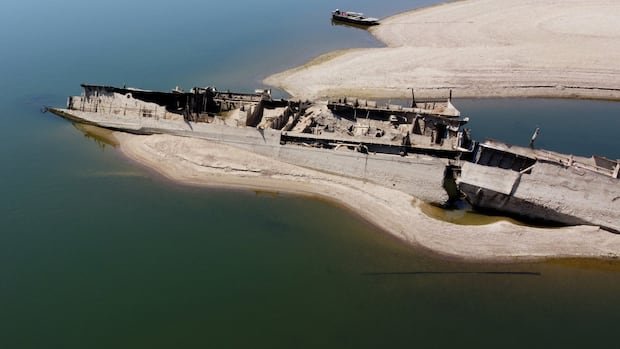

Nazi German warships that were deliberately sunk in the Danube River during World War II are emerging due to decreasing water levels, a stark indicator of the intense heat and drought currently affecting Europe. The fifth heatwave in Europe since May is expected to hit western parts of the continent starting Tuesday, with temperatures nearing 40°C in Spain, France, and Italy before rising even higher in central and northern Europe. The Copernicus climate monitoring service of the European Union confirmed that June and July marked the hottest months on record in western Europe, leading to an estimated 25,000 heat-related deaths.
The scorching temperatures have triggered devastating wildfires and led to historically low water levels in crucial water bodies like the Danube. Climate experts warn that the exposed warship wrecks are a visible consequence of the escalating impacts of fossil fuel-induced climate change, intensifying heatwaves, droughts, and their repercussions on wildfires, agriculture, shipping, and energy infrastructure across Europe.
Historical records suggest that up to 200 Nazi warships were intentionally sunk near the Serbian city of Prahovo in September 1944 to impede advancing Soviet forces. Unusually low water levels in the Danube have also unveiled a German military motorcycle in Hungary, an unexploded British bomb in Slovakia, and potentially ancient mammoth remains in Bulgaria. The dwindling water levels have raised urgent concerns for countries along the Danube, prompting measures such as water use restrictions for irrigation and innovative solutions to sustain critical infrastructure like nuclear power plants.
Climate data comparing temperatures from 1944 to 2026 highlights a significant increase in average surface air temperatures across Europe, particularly in the western region. Experts emphasize that the current extreme weather events are a clear illustration of how climate change is exacerbating heatwaves and droughts, creating a cycle of reinforcement between the two phenomena. As the Danube river reaches critically low levels, the environmental impacts, including forest and agricultural damage, have already materialized, signaling the need for proactive measures to mitigate future consequences.
Looking ahead, experts warn that the emergence of a potential ‘super El Niño’ event in the southern Pacific Ocean could further exacerbate global temperatures in the coming years. The continuous emission of greenhouse gases is projected to amplify the effects of climate change, underscoring the urgency for immediate action to curb emissions and mitigate the impacts of extreme weather events on a global scale.