
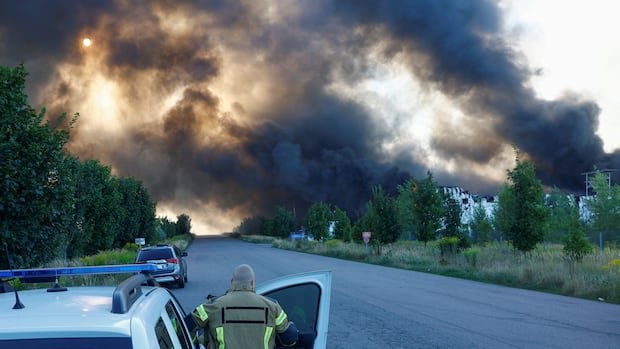

In a nighttime aerial assault that spanned several hours, Russia launched a barrage of missiles and drones on the Ukrainian capital Kyiv and its nearby areas, resulting in the deaths of at least 16 individuals, as per officials on Thursday.
The Russian forces have notably escalated their ballistic missile strikes on Kyiv in recent times, taking advantage of Ukraine’s limited supply of U.S.-manufactured Patriot air defense interceptors, the only weaponry capable of intercepting ballistic missiles in its arsenal. Ukrainian President Volodymyr Zelenskyy has made urgent appeals for additional Patriot interceptors from other nations, but global stockpiles are running low due to ongoing conflicts like the Iran war and Ukraine’s prolonged battle against Russia’s full-scale invasion.
The assault by Russia also involved cruise missiles and high-speed jet-powered drones, adding further pressure on Ukraine’s air defenses, as stated by the Ukrainian air force. Explosions reverberated throughout the city during the night, with Kyiv being the primary target, although strikes were reported at 28 different locations across the country. Zelenskyy disclosed that around 40 people sustained injuries, with air raid sirens remaining active until dawn.
Describing the attack as significant, Zelenskyy remarked on social media that Russia meticulously planned the assault, combining various types of missiles and drones to inflict maximum damage on civilian infrastructure. The Russian Defense Ministry claimed that the strike targeted a Kyiv industrial site involved in producing components for Ukraine’s Flamingo cruise missiles, as well as facilities related to drone production, ammunition storage, and logistics.
Simultaneously, neighboring nations and allies swiftly mobilized their military assets in response to the unfolding crisis. Poland’s Armed Forces Operational Command activated military aviation operations, ground-based air defense systems, and radar reconnaissance in reaction to the Russian attack on Kyiv. Furthermore, Polish and other NATO military aircraft were deployed to monitor the airspace over Poland, as reported by the Polish news agency PAP.
Romania’s Defense Ministry disclosed that an unidentified drone crashed and caught fire near the Ukrainian border. Additionally, two Spanish F-18 jets, stationed in Romania for air policing duties, were scrambled to monitor suspicious aerial activities close to the border. Moldova also reported an unauthorized drone breaching its airspace during the escalating tensions.
Ukrainian Foreign Minister Andrii Sybiha criticized Russia’s actions, highlighting that the country was increasingly challenging NATO and its partners by violating neighboring states’ sovereignty and expanding the conflict’s risks beyond Ukraine. Amid these developments, Ukraine’s quest for missile defense systems faces hurdles, with a significant decrease in U.S. Patriot inventory post-war, despite the Pentagon’s substantial reserves.
The overnight strikes in Kyiv targeted multiple districts, resulting in damage to residential buildings, a medical facility, and an educational institution. Emergency response teams worked tirelessly to rescue individuals trapped under debris, with numerous structures sustaining severe damage. Larysa Bondaruk, a resident affected by the strikes, recounted the chaos and destruction caused by the rockets, expressing gratitude for the swift response of rescue teams despite the tragic loss of lives.
Ukraine has sought to shift the conflict onto Russian territory through long-range drone attacks on critical infrastructure. The Russian Defense Ministry reported the downing of 726 Ukrainian drones overnight in various Russian regions and seas, marking one of Ukraine’s most extensive aerial offensives of the war, albeit without immediate reports of casualties or damage. Ukrainian forces targeted Russia’s TANECO oil refinery in the Tatarstan region and the Tamanneftegaz oil terminal in the Krasnodar region, as per the Ukrainian General Staff.
The ongoing drone and missile exchanges between Russia and Ukraine have created a stalemate on the extensive 1,250-kilometer front line, with both sides struggling to gain a decisive advantage as drones play a crucial role in military strategies.