
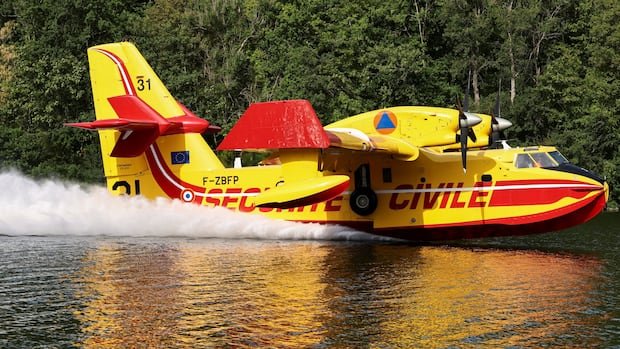

Amid a severe wildfire season in Canada, the United States, and Europe, there is mounting pressure on the manufacturer of the Canadair “Super Scooper” water bombers to ramp up production and on the federal government to place bulk orders for these planes.
De Havilland, based in Calgary, has taken the unusual step of restarting production of the Canadair following its acquisition of the water bomber program, previously managed by Bombardier until 2015. The renowned aircraft are meticulously crafted by hand, with most assembly work done in Calgary using components from various parts of the country. The resurgence of the production line was announced in 2022, and progress is evident as the first two aircraft are currently under construction and are expected to be ready for delivery by early 2028.
Political leaders in Canada and Europe are eager to secure these aircraft due to existing shortages and aging fleets. Originating in the 1960s, the Canadair amphibious firefighting planes were specifically designed for combatting massive wildfires in the remote Canadian wilderness. Their unique capabilities enable them to maneuver through narrow canyons at low altitudes and swiftly scoop up thousands of liters of water from lakes, rivers, and oceans.
Recent criticism from opposition politicians in France and Spain has highlighted the inadequacy of operational Canadairs in addressing extreme weather events and wildfires. Provincial leaders in Canada, like Manitoba’s Wab Kinew, have expressed concerns over the shortage of new water bombers in consecutive summers, emphasizing the urgent need for more resources.
The surge in demand has prompted De Havilland to contemplate establishing a second production line to meet the escalating requirements. Alberta Premier Danielle Smith is collaborating with provincial counterparts and the federal government to advocate for a substantial order from Ottawa that would provide the necessary assurance for the manufacturer to initiate the construction of a second line.
Presently, De Havilland has orders for 38 water bombers, with a delivery timeline ranging from 2032 to 2033. The company, which employs around 4,000 individuals primarily in Calgary, Ontario, and Victoria, has the capacity to manufacture approximately 10 water bombers annually at full capacity. Introducing a second production line could potentially double the output to 20 planes per year.
Experts like John Gradek from McGill University underscore the pressing need for additional production lines for Canadairs to meet the global demand arising from the worsening wildfire crisis worldwide. The threat of potential competition from foreign companies developing rival firefighting aircraft looms large, posing a risk to Canadian manufacturing jobs.
The Senate report released in June recommends the establishment of a national fleet of modern firefighting aircraft to address the increasing wildfire challenges in Canada. The federal government has taken steps this year by leasing 10 airplanes and helicopters to assist provincial wildfire crews during the summer season.
While aircraft play a crucial role in wildfire management by slowing down the spread, creating perimeters, and reducing heat to support ground crews, they are just one component of a comprehensive firefighting strategy. The federal government is committed to enhancing national resilience in responding to escalating wildfire seasons and collaborating closely with provinces and territories to bolster firefighting capabilities.
The Canadair water bombers, priced at approximately $80 million per aircraft according to government estimates, have been a pivotal asset in firefighting efforts over the past six decades. However, sustaining this legacy for the future hinges on meeting the growing demand and ensuring continued production of these critical aircraft.