
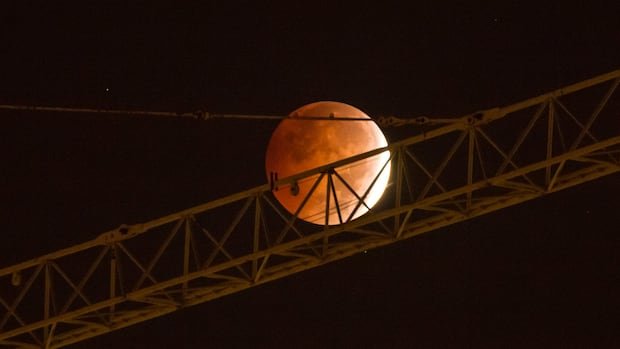

On the night of August 27-28, a deep partial lunar eclipse with 93% coverage at its maximum will be visible across Canada. Lunar eclipses occur when the moon moves through Earth’s shadow, passing through the outer penumbra before entering the umbra, which is difficult to see with the naked eye due to its dimness.
Most parts of Canada will witness the entire eclipse duration, with Western Canada catching the partial eclipse as the moon rises. Unlike solar eclipses, no protective eyewear is needed to observe lunar eclipses, which unfold over hours rather than minutes.
The eclipse will commence as the moon enters Earth’s penumbra around 10 p.m. ET, though the visible phase starts at 10:33 p.m. ET on August 27 and concludes at 1:52 a.m. on August 28. The deepest eclipse at 12:13 a.m. will showcase most of the moon darkened.
Elaina Hyde, director of York University’s department of physics and astronomy, described the eclipse as a notable astronomical event amidst a month filled with celestial occurrences. While it’s not expected to be a “blood moon,” parts of Canada may witness a reddish hue during the eclipse.
Lunar eclipses offer a spectacle that can be enjoyed with the naked eye, and for those with binoculars, a small telescope, or a smartphone with a quality night mode, capturing memorable images is possible.