
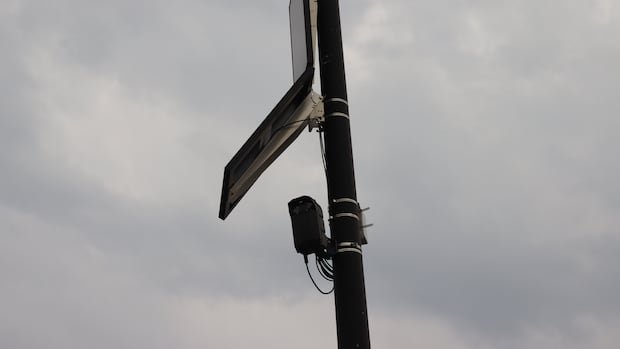

Montreal police have been expanding their utilization of AI-powered technology to monitor both vehicles and individuals throughout the city discreetly, prompting concerns regarding transparency and privacy rights among the public. A recent discovery by a Radio-Canada journalist revealed a high-tech camera capable of scanning and identifying vehicles placed on a lamp post along Henri-Bourassa Boulevard in Montreal’s Rivière-des-Prairies neighborhood. This camera, identified as a Cloudrunner CR-H2 manufactured by Genetec, a Montreal-based company, was promptly removed following media coverage.
Similar to the contentious Flock Safety cameras commonly seen in the United States, the Genetec system goes beyond simply scanning license plates. It can also record and retain specific details about vehicles, such as their color, make, and model. Unlike Flock cameras that share data in a central database accessible to various police entities, Genetec’s system ensures that the collected information is handled by its designated operator.
According to SPVM spokesperson Marc-Antoine Bélanger, access to the captured images is restricted to investigators handling the relevant cases. The decision to remove the camera was explained as a measure to safeguard ongoing investigative strategies. The SPVM justifies keeping its technological tools undisclosed to prevent impeding complex investigations.
Critics argue that the introduction of new technology lacks transparency. Dominique Peschard from the Ligue des droits et libertés, a Quebec human rights organization, emphasizes the importance of informing the public about the tools being employed by law enforcement without compromising their effectiveness.
The deployment of Cloudrunner cameras forms part of a broader adoption of AI-driven technology by the SPVM. The police department has confirmed the use of iMotion ROC AI software from Rank One Computing to assist investigators in analyzing extensive video footage. The SPVM denies utilizing the software for facial recognition or biometric purposes, asserting that it focuses on identifying specific elements within video content.
An internal privacy impact assessment by the SPVM acknowledges potential civil liberties risks associated with the technology, including the inadvertent investigation of innocent bystanders and the risk of discrimination based on apparent social characteristics. The assessment suggests that configuring the software to search for objects rather than identifiable traits, such as ethnicity, could mitigate discrimination risks.
The revelation about the Cloudrunner camera came after initial confusion within the SPVM. Despite some uncertainties, it was confirmed that the device was being used to target armed violence and vehicle thefts. The chief’s unawareness of the technology’s utilization raised concerns about oversight and protocol implementation within the police department.
While only one Cloudrunner camera was identified and removed, the SPVM suggests the possibility of adding more cameras based on the requirements of investigations dealing with specific criminal activities. Genetec’s vice-president, Andrew Elvish, emphasizes the technology’s privacy-respecting design and detailed data logging mechanisms. He highlights the community’s trade-off between privacy and safety in the face of potential threats.
In response to inquiries, the City of Montreal clarified that it had not installed the Cloudrunner camera and directed deployment-related questions to the SPVM. The city’s mayor had previously advocated for a voluntary security camera registry during the municipal election campaign to assist law enforcement in mapping out the locations of residents’ home surveillance cameras.
The use of AI-powered surveillance tools underscores the need for stringent restrictions to safeguard individual privacy in public spaces. Legal experts emphasize that inadequate control over privacy may result in compromising individuals’ rights within the public domain.