
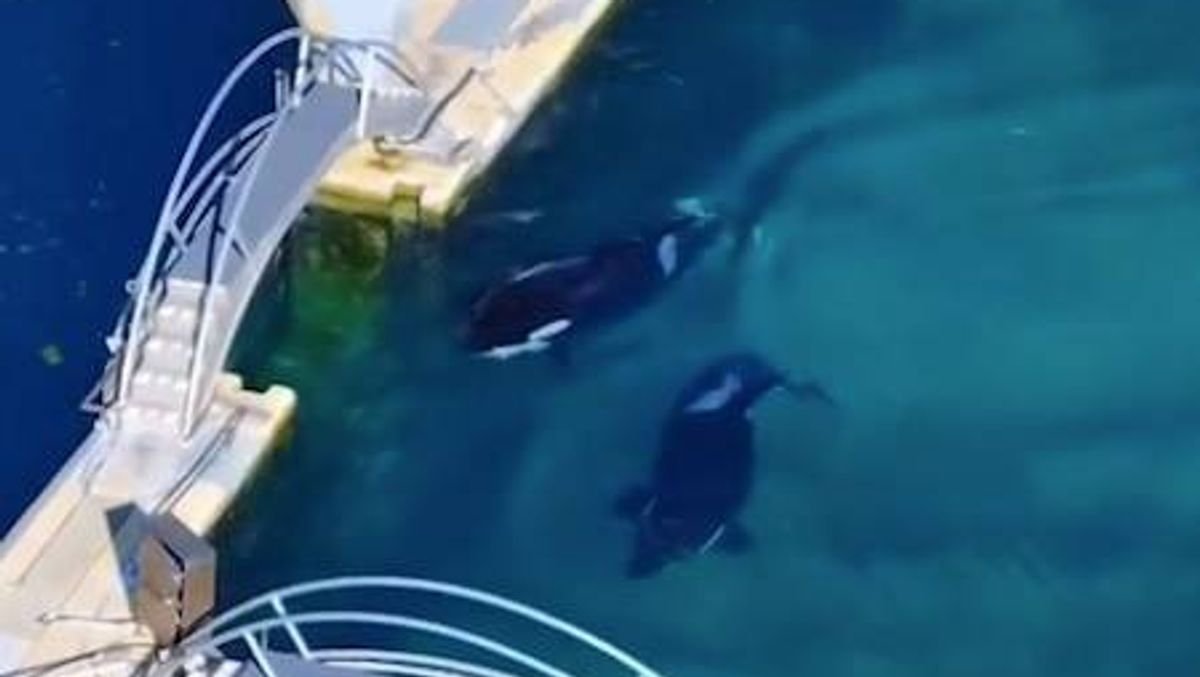

The last two killer whales held in captivity in France are at risk of perishing due to government inaction regarding their abandoned marine park, activists have cautioned.
Wikie and her son Keijo are the sole remaining killer whales in France, left swimming in a deteriorating tank after Marineland Antibes closed permanently earlier this year. They are the only survivors of their original group of four, spending their days devoid of stimulation and yearning for the connections they once had with their deceased family members.
The closure of the park has led to neglect, with the orcas’ tank becoming increasingly polluted and overgrown with green algae. Despite minimal care and interaction from a reduced staff, Wikie and Keijo have been forgotten by the crowds they used to entertain.
In a nearby smaller tank, 12 bottlenose dolphins are the park’s only other residents, facing a similar fate. Cetacean advocacy group TideBreakers has been urging the French government to intervene and rescue the animals before it is too late.
The park’s closure came after years of pressure from animal protection organizations, including PETA, and various efforts to relocate the animals to safer environments by collaborating with celebrities like Pamela Anderson.
However, disagreements between French authorities and the park’s management, who are legally responsible for the animals’ welfare, may prolong the situation until it is too late for the creatures.
New legislation has banned entertainment shows featuring whales, dolphins, and porpoises, setting a deadline for Marineland to relocate the animals by December 2026. Despite this, proposals to move the orcas to Japan or Canada have been rejected, citing welfare concerns and logistical challenges.
The French government is exploring alternative options, while campaigners stress the urgency of the situation, fearing that Wikie and Keijo may not survive much longer in their current conditions.
In a recent development, the French government has proposed transferring Wikie and Keijo to a sanctuary in Nova Scotia, Canada, supported by the Whale Sanctuary Project. This decision represents a significant step towards providing these social animals with a more natural and spacious environment, ensuring their well-being and safety. The transfer could potentially take place as early as summer 2026, pending approval from Marineland.