
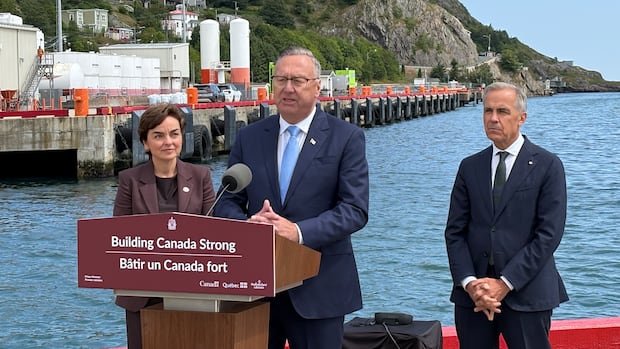

Ottawa has announced what is being hailed as the most significant clean energy investment in North American history. Prime Minister Mark Carney, along with N.L. Premier Tony Wakeham and Quebec Premier Christine Fréchette, revealed a groundbreaking deal concerning Churchill Falls and other electricity ventures in Labrador.
The agreement involves a substantial $10 billion in funding from Ottawa to enhance the Churchill Falls generating station, develop the Gull Island hydroelectric project, construct transmission lines, and introduce a 2,000 MW onshore wind energy initiative in Labrador. These projects, valued at nearly $70 billion, will substantially increase the current generating capacity of Churchill Falls, providing enough energy to power residences in Toronto, Montreal, and Vancouver combined.
Carney emphasized the significance of this investment, surpassing the generating capacities of major energy providers such as B.C. Hydro and Bruce Power. The projects are estimated to generate 23,000 job opportunities. The deal is expected to benefit Quebec by offering a reliable power source while aiding Newfoundland and Labrador in addressing financial challenges.
Moreover, the agreement aims to reduce electricity costs for Newfoundlanders and Labradorians. A new 15% rebate on the first 2,000 kWh of monthly electricity usage is set to save households an average of $351 annually.
Describing the agreement as a “win-win-win,” Wakeham highlighted the updated figures compared to the 2024 memorandum of understanding. The deal is projected to increase N.L.’s value to $49 billion in net present value.
The partnership guarantees transmission access of 985 megawatts through Quebec, enabling Newfoundland and Labrador to sell excess power to other markets. This contrasts with the previous agreement, where Quebec had first access to unused energy designated for N.L.
The agreement also includes potential wind project development and upgrades to the existing facility, increasing its capacity by 23.5%. The projects will result in Newfoundland and Labrador gaining approximately 760 MW more power, with the potential to reach 2,750 MW post-wind project completion.
Furthermore, the agreement will facilitate the expansion of Labrador’s mining sector, with Ottawa providing financial support for development. However, uncertainties loom as Quebec braces for an upcoming election, potentially impacting the longevity of the agreement under new leadership.
The transformative deal underscores the collaborative effort between provinces to drive clean energy initiatives and bolster economic growth in the region.