
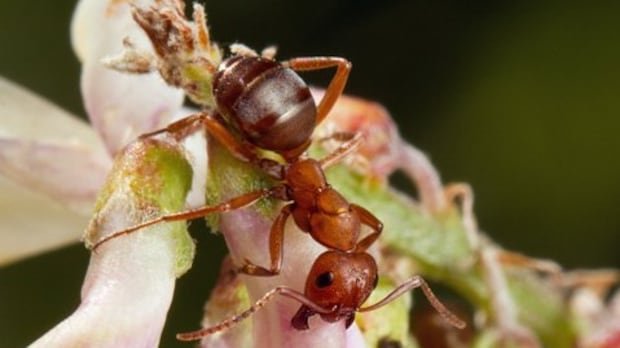

In the southeastern part of Alberta, the Cypress Hills stand out amidst the flat prairie landscape. Amidst this striking scenery, a peculiar drama unfolds involving ants in Cypress Hills Provincial Park. These ants find themselves latched onto plants and shrubs, awaiting the chance to be ingested by unsuspecting herbivores. The instigator behind this bizarre scenario is the parasite known as Dicrocoelium dendriticum, a worm with the remarkable ability to manipulate its host like a zombie.
Researchers from the University of Calgary and University of Lethbridge have highlighted the unique capabilities of this parasite in controlling its host, distinguishing it as a standout among parasitic manipulations. While zombie parasites are not uncommon in nature, the ability of these organisms to influence their hosts for their own benefit is a widespread phenomenon across various species.
The primary objective of such parasitic manipulations is often to facilitate the transition from one host to another. For instance, well-known examples include the Cordyceps fungus, as seen in popular media like the video game “The Last of Us,” where infected ants climb plants to aid the fungus in spreading its spores. Similarly, the horsehair worm compels crickets to take their lives by jumping into water for the worms’ reproductive cycle.
Unlike most cases in the animal kingdom where host death is a typical outcome, Dicrocoelium exhibits a different strategy due to its intricate life cycle involving multiple hosts. The final hosts, such as elk, deer, or cattle, harbor adult worms in their livers. The parasite’s eggs are excreted and consumed by snails, leading to the development of larval forms called cercaria. These larvae are ingested by ants, with all but one moving to the abdomen while a single “brainworm” positions itself near the ant’s brain.
The challenge for the parasite arises from the fact that the final hosts rarely consume ants as part of their diet. In response, the brainworm manipulates the ants to climb plants, increasing the likelihood of accidental ingestion by grazing mammals. This manipulation tactic poses risks for the ants, exposing them to predators, hindering their ability to feed, and making them highly vulnerable to dehydration.
To address these challenges, the brainworm employs a unique mechanism that allows the infected ants to alternate between clinging to plants and returning to their nests based on external temperature conditions. The ability of the parasite to regulate its host’s behavior in response to environmental cues raises intriguing questions about the underlying mechanisms driving such control.
Researchers are delving into the genetic and biochemical changes induced by the parasite within the ant’s brain during this manipulated behavior. By deciphering these alterations and their effects on the host, scientists aim to unravel the intricate chemical processes that underpin parasitic control over host behavior.
While the exact mechanisms of host manipulation remain complex and multifaceted, scientists are making strides in identifying potential molecules involved in this intricate interplay, such as adenosine. This molecule, known for its roles in immune responses, neural functions, stress regulation, feeding behavior, and sleep patterns, offers insights into how the parasite exerts its influence over the host.
Understanding the nuances of how parasites like Dicrocoelium alter host behavior provides valuable insights into the intricate workings of brains and behavioral responses. By studying these interactions, researchers aim to shed light on the intricate chemical signaling mechanisms that parasites exploit to manipulate their hosts.
The presence of Dicrocoelium in Cypress Hills serves as a reminder of the consequences of human-induced disruptions in natural ecosystems. The introduction of this parasite to Canada through historical animal imports from Europe underscores the impact of human activities on disease transmission and ecological balance. By studying the factors that enable the proliferation of such parasites, researchers can glean insights into managing emerging diseases and preserving ecosystem health.