
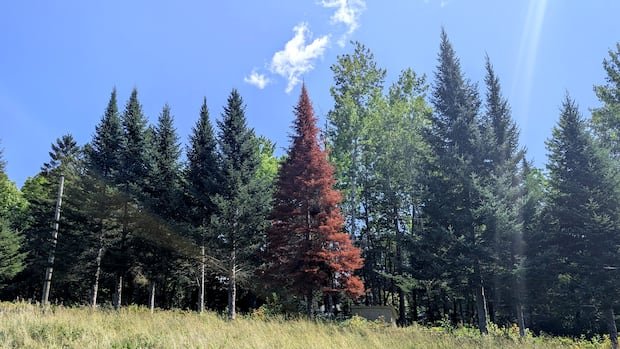

Balsam fir trees in New Brunswick are exhibiting a concerning trend of turning red and perishing following the severe drought experienced last summer, prompting worries about the survival of this key provincial tree. Professor Anthony Taylor, a forestry researcher at the University of New Brunswick, has been closely monitoring reports from woodlot owners and witnessing the visible damage firsthand. The typically lush evergreen balsam firs, often sought after for Christmas trees, are gradually transforming into a red, desiccated state before succumbing to death.
According to Prof. Taylor, the observed pattern aligns with previous instances following hot and dry summers. He emphasized that the warm and arid conditions, as seen during the recent drought, have a detrimental effect on the growth potential of balsam firs. Taylor, who has been researching the impact of climate change on New Brunswick’s forests for an extended period, noted similar die-offs in balsam firs post unusually hot and dry summers in 1986 and 2018.
The adverse impact of drought conditions leads the trees to prematurely halt the photosynthesis process, stunting their growth. This interruption prevents them from generating essential energy stores necessary for fundamental metabolic functions and the production of defense compounds, as explained by Taylor. He highlighted that this disadvantaged state makes the trees more susceptible to stressors, such as insects or pathogens, increasing the likelihood of die-off.
Moreover, balsam firs possess shallow roots, complicating their ability to access water during dry periods. Woodlot owner Peter McKeil first observed signs of damage to balsam firs on his property in June, noting a gradual reddening from lower branches upward, indicating ongoing mortality. McKeil estimated losing approximately 100 trees to date and has adjusted his harvesting practices to salvage remaining firs before further losses occur.
McKeil voiced concerns about the future viability of the species, particularly in southern New Brunswick, attributing the grim outlook to worsening climate change effects. He anticipates a necessity for adaptation or potential disappearance of the fir species as a consequence of evolving environmental conditions. Taylor echoed these sentiments, emphasizing the urgent need for climate action to mitigate the escalating impacts on New Brunswick’s iconic balsam firs.
As a visible indicator of climate change consequences, the red-hued trees serve as a tangible reminder of the challenges facing the provincial tree. Taylor likened the situation to a proverbial canary in a coal mine, urging for swift societal actions to curtail reliance on fossil fuels and excessive deforestation. He stressed the imperative for accelerated climate change mitigation efforts to prevent further ecological disruptions in the future.