
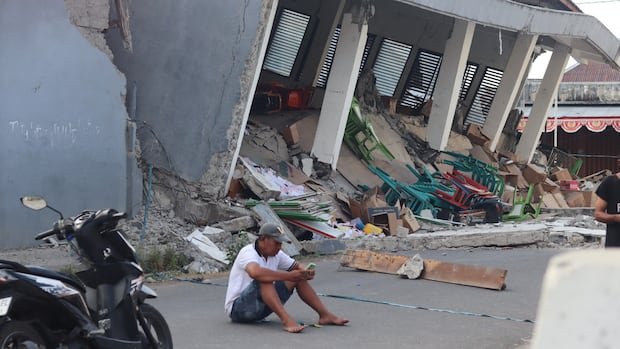

Around 5,000 individuals have been relocated following a devastating magnitude-7.7 earthquake that struck eastern Indonesia, resulting in a minimum of 53 fatalities, road blockages, and landslides, as confirmed by authorities on Sunday. Over 130 individuals have sustained injuries, with many suffering from fractures.
This earthquake, which occurred on Saturday, marks Indonesia’s deadliest since a similar event in 2022 that claimed hundreds of lives in West Java. The disaster mitigation agency BNPB reported that more than 3,300 people in the Sikka region either self-evacuated or sought refuge in a sports arena.
In the aftermath, some Sikka residents found themselves stranded outside collapsed residences, taking shelter under makeshift tarps. Meanwhile, individuals received medical attention in outdoor tents near a hospital in Maumere.
Simon Subandi, the deputy regent of Sikka, shared that nearly all residents chose not to stay indoors after the quake, opting to sleep on porches or makeshift tents outside. Responding to the crisis, more than 3,500 military and police personnel have been dispatched to the affected area.
Concerns of aftershocks loom large in Maumere, where a closed port remains strewn with debris. Residents expressed fear over potential aftershocks as the disaster agency reported close to 1,000 aftershocks post the main quake. Nearby, a sports stadium has been designated as an evacuation center, with residents queuing up for warm beverages as the sun sets.
The head of the region’s disaster mitigation agency, Margaretha Movaldes Da Maga Bapa, noted that the recent quake has reignited memories of a previous earthquake in 1992, evoking deep-seated trauma among residents. Search and rescue efforts are ongoing, with a focus on clearing rubble in the hardest-hit areas to locate any possible survivors.
Despite nearly full restoration of power supply, repair work on distribution lines continues. The East Nusa Tenggara government has declared an emergency for the province, enabling the mobilization of resources and funding for relief efforts.
Geology expert Dwikorita Karnawati highlighted the seismic risks in the region due to the “Flores back-arc thrust fault,” emphasizing the area’s susceptibility to earthquakes. Notably, the same area was struck by a magnitude-7.5 earthquake in 1992, causing widespread devastation.
Indonesia, with its vast population of 290 million, lies within the seismically active “Pacific Ring of Fire,” where tectonic plate interactions lead to frequent earthquakes and volcanic activities.