
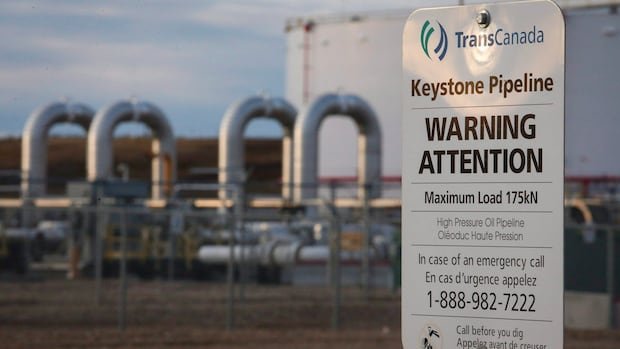

U.S. President Donald Trump has announced the potential revival of the controversial Keystone XL oil pipeline project amid ongoing trade discussions between Canada and the United States to prevent new U.S. tariffs on Canadian products.
In a post on his Truth Social platform, Trump hinted at the resurrection of the Keystone XL Pipeline, which was halted by President Joe Biden. He shared an AI-generated image depicting him lifting a large pipeline labeled “KEYSTONE” from a grave, with patriotic symbols and a headstone reading “Buried by Biden.”
While Canada has not publicly responded to Trump’s statement regarding the project’s revival in trade talks, Washington announced a temporary halt on planned 50% tariffs on various Canadian goods for three days to facilitate further negotiations.
The history of the Keystone XL expansion dates back to July 2008 when it was initially proposed during Stephen Harper’s tenure as Canadian Prime Minister and the end of George W. Bush’s presidency in the U.S. The project faced opposition and environmental concerns, leading to various legal challenges and route changes over the years.
Despite the termination of the Keystone XL project by TC Energy in June 2021, recent developments suggest a potential rekindling of interest. Trump’s authorization of a proposed Canada-Wyoming oil pipeline project in April 2026, and his subsequent postponement of new tariffs on Canadian goods, indicate a possible resurgence of the Keystone XL initiative.
South Bow, a Canadian company involved in the project, has expressed intentions to explore options to meet the growing demand for Canadian oil, even though they have moved on from the Keystone XL endeavor. Discussions between Prime Minister Mark Carney and Trump in October 2025 hinted at renewed Canadian interest in the Keystone XL pipeline.
Looking forward, South Bow is expected to make a decision on proceeding with the Prairie Connector project, a potential alternative to the original Keystone XL route, by mid-2027. The proposed project aims to transport oil from Alberta to Wyoming, utilizing parts of the existing Keystone XL infrastructure on the Canadian side.
In a recent development, the U.S. government reached a settlement with South Bow regarding the significant oil spill in Kansas in 2022, with the company agreeing to pay substantial civil penalties and contribute towards environmental restoration efforts.
Trump’s recent statement suggesting the potential revival of the Keystone XL project aligns with his efforts to postpone new tariffs on Canadian goods, hinting at a possible reemergence of the once contentious pipeline initiative.