
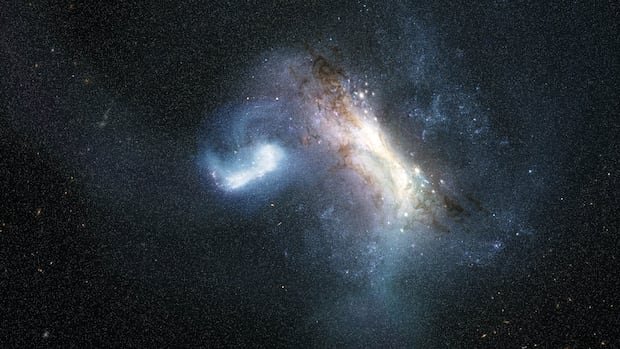

A groundbreaking study has unveiled a significant event in the early history of the Milky Way galaxy. Researchers have identified evidence suggesting that approximately 11.8 billion years ago, when the universe was in its infancy, the Milky Way absorbed a smaller galaxy. This galactic merger, the earliest known for the Milky Way, played a crucial role in the galaxy’s growth by incorporating stars from the dwarf galaxy into its own structure.
The dwarf galaxy involved in the merger was distinctly smaller than the Milky Way, estimated to contain stars with a mass equivalent to 500 million times that of the sun at the time of the event. The merger added to the Milky Way’s stellar population and cosmic material, including dark matter, fueling further star formation.
Utilizing advanced telescopes such as the Hubble and Gaia, scientists studied stellar clusters within the innermost 20,000 light-years of the Milky Way, analyzing their age, composition, and trajectory. These stars, originating from the merged dwarf galaxy named Low-energy-Kraken-Heracles (LKH), became integral parts of the Milky Way approximately two billion years after the Big Bang.
Astrophysicist Davide Massari, the lead author of the study published in Nature Astronomy, emphasized the significance of this discovery, highlighting that the merger significantly impacted the Milky Way’s evolution by contributing stars and gas that fueled star formation processes.
Massari noted that while the merger itself was relatively peaceful for the stars, it triggered an explosive collision of gases, leading to the formation of numerous new stars. The merger with LKH was just one of several significant galactic interactions the Milky Way has experienced, including mergers with Gaia-Sausage-Enceladus and the Sagittarius dwarf galaxy, each leaving a unique imprint on the galaxy’s development.
Understanding these galactic mergers is crucial in unraveling the origins of our solar system and Earth itself, shedding light on the fundamental question of our cosmic origins.