
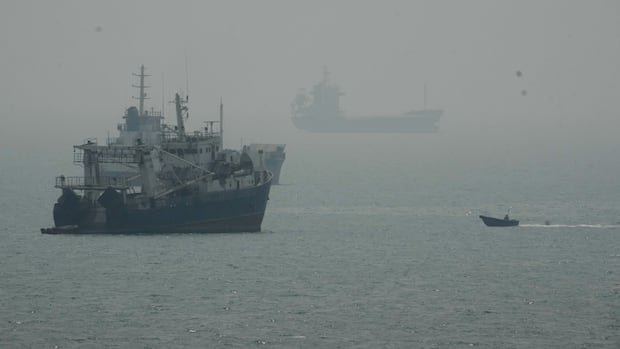

Iran announced on Wednesday that it had conducted a series of attacks on 10 ships near the Strait of Hormuz in response to the sinking of five Iranian oil tankers by the United States. This exchange of attacks marks the most significant escalation in maritime hostilities between the two sides since the onset of the six-month-long conflict.
The Islamic Revolutionary Guard Corps (IRGC) of Iran stated that it had carried out a ballistic missile strike on a U.S. military base near Al Azraq, located in eastern Jordan. Additionally, Iran reported firing upon two U.S. vessels and eight oil tankers that were attempting to traverse a restricted area in the Strait of Hormuz as declared by Iran.
These incidents in the strategic waterway led to a surge in oil prices, with the international Brent crude benchmark surpassing $100 per barrel for the first time since July. The ongoing conflict has disrupted oil markets, with hopes of a resolution between the U.S. and Iran to ensure safe passage of oil tankers out of the Persian Gulf now dashed.
The escalating conflict between Saudi Arabia and the Iran-aligned Houthis in Yemen has added further uncertainty to energy markets. Recent attacks by the Houthis in Saudi Arabia caused significant fires at oil facilities, impacting global oil supply.
The rise in fuel prices has affected consumers, with gasoline prices in the U.S. reaching an average of $4.15 per gallon, a 26% increase from the previous year. Diesel prices have surged even higher, standing at $5.90 per gallon, marking a 59% year-over-year increase.
Amidst the escalating tensions, the Bank of America analysts expressed skepticism about the likelihood of a lasting resolution before the U.S. midterm elections. In response to the soaring fuel prices, the Canadian government has extended the gas tax holiday until the end of January.
Iran unveiled a restricted maritime zone extending from Chabahar in Iran to parts of the Gulf of Oman and the Arabian Sea. This move follows Iran’s announcement of establishing a restricted zone outside the Strait of Hormuz, as indicated by Mohsen Rezaei, the secretary of Iran’s Supreme National Security Council.
In a separate incident, a drone strike targeted a tanker carrying two million barrels of Iraqi fuel oil in Iraqi territorial waters, causing a fire onboard. The United Kingdom Maritime Trade Operations reported vessels in the northern Gulf and Gulf of Oman being hit by disabling fire during military activities in the region.
Iran’s actions have disrupted the flow of oil and other resources through the vital Strait of Hormuz, impacting global energy markets. The U.S. has responded with a blockade of Iranian ports to mitigate the effects of Iran’s actions on oil transportation.
Despite efforts to guide tankers through the strait, the full extent of oil shipments escaping the blockade remains uncertain. The conflict continues to escalate, with both sides engaging in retaliatory attacks on maritime and military targets.
Preliminary data indicates a decrease in ship crossings in the region, reflecting the heightened tensions and disruptions caused by the ongoing conflict. The situation remains volatile, with both Iran and the U.S. demonstrating their military capabilities in the region.