
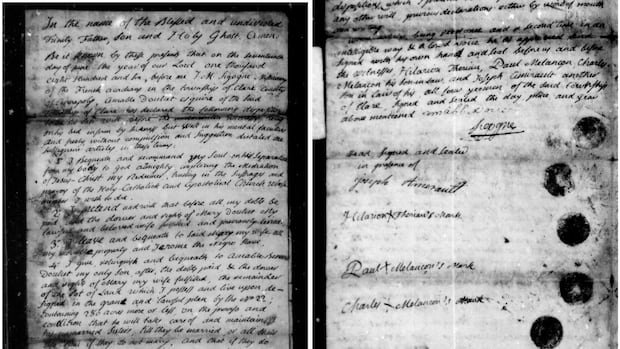

Hilarion Thériault, at the age of 71, departed from the norm by creating a will, an unusual act among Acadians in the 19th century due to the scarcity of property following the Acadian deportation. The loss of land and homes post-deportation, coupled with restrictions on property ownership for Roman Catholics until the late 18th century, hindered the passing down of assets. However, Thériault, ensuring he was well-prepared for his passing, left a detailed will.
Colby Gaudet, a post-doctoral fellow at Dalhousie University, delved into Thériault’s will and 23 others from Clare, N.S., to explore how families managed legal and religious protocols related to death and mourning. Gaudet highlighted the dual nature of using established Anglophone property frameworks while asserting their Roman Catholic beliefs in the wills.
Thériault’s will stipulated the settlement of debts, reparations for any wrongdoings in his name, and the desire for familial peace. Maurice Basque, a historian at l’Institut d’études acadiennes at the Université de Moncton, contextualized these wills within the social ostracism faced by Acadians post-deportation.
The wills shed light on the systematic challenges faced by Acadians, including language barriers with predominantly Anglo-Protestant judges overseeing wills. All the wills studied by Gaudet were authored by the priest Jean-Mandé Sigogne, who acted as a crucial link between the Acadian community and the judicial system.
Gaudet’s research unveiled the unapologetic Catholic influence in the wills, emphasizing the integration of Catholicism into daily life despite societal stigmatization. The wills, often left by community leaders, reflected a strong commitment to their faith, incorporating Catholic details like invoking saints and the Virgin Mary.
Furthermore, the wills provided insights into the relationships between Black individuals and Acadians. Notably, Amable Doucet’s will, bequeathing a Black slave named Jerome to his wife, and Étienne Thibodeau’s choice of Black neighbors as witnesses, highlighted the intertwined histories of Acadians and Black individuals in the community.
The study of these wills not only offers a glimpse into the legal and religious practices of the time but also showcases the resilience and cultural identity of the Acadian community in face of adversity.