
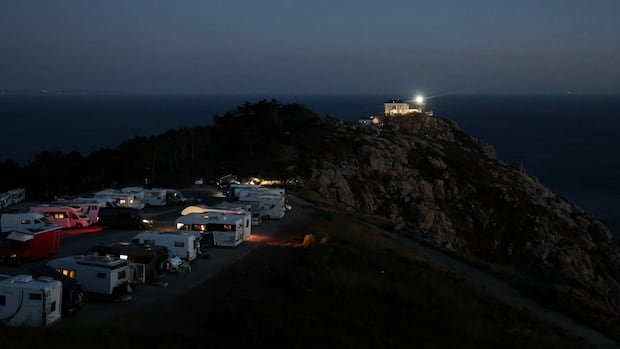

Hundreds of thousands of visitors have flocked to Spain to witness the solar eclipse happening this Wednesday. However, the event coincides with high temperatures and an increased risk of wildfires in the country, causing concern for authorities aiming to prevent any lasting fire damage resulting from the surge in astrotourism.
Virginia Barcones, the secretary general for civil protection and emergencies at Spain’s Interior Ministry, emphasized the need to curtail activities that could potentially spark fires due to the challenging wildfire season the country has been experiencing. With a heat wave affecting Europe since May and Spain facing a severe wildfire season, approximately 603,000 acres of land have already been scorched in nearly 400 fires this year, as reported by the European Forest Fire Information System.
To mitigate the risk of additional fires during the eclipse, authorities are mobilizing 35,000 officers on Wednesday to monitor large outdoor gatherings and promptly address any potential fire incidents, as mentioned by Barcones. Spain is a prime viewing spot for the solar eclipse, with the path of totality spanning various countries including northern Russia, eastern Greenland, western Iceland, northeastern Portugal, and a substantial area of northern Spain, culminating at the Balearic Islands.
Only individuals within the path of totality will witness the sun fully obscured by the moon. While a partial eclipse will be visible in parts of Canada, viewers are advised to use eclipse glasses for eye protection. This will mark the first time in 120 years that mainland Spain will witness a complete solar eclipse, generating a surge in travel interest.
Precautionary measures approved by the Ministry of the Interior have been put in place for the eclipse, anticipating a significant influx of over 440,000 people and estimating up to 1.5 million individuals traveling to viewing sites. Both national and local authorities are cautioning tourists against using barbecues and venturing into dry countryside where the risk of fire is heightened.
The economic impact study by the Ministry of Economy, Trade, and Business forecasts that the eclipse could contribute over 347 million euros to Spain’s economy. Despite ongoing wildfires and a heatwave, the enthusiasm for the eclipse remains high among travelers, reflecting the awe-inspiring nature of the celestial event.
As the eclipse coincides with very high fire risk levels, officials are closely monitoring conditions, with AEMET predicting temperatures exceeding 35 degrees Celsius on the day of the eclipse. The forest fire index across Spain is expected to reach extreme levels, emphasizing the need for vigilance to prevent potential fire outbreaks.
The eclipse fervor continues unabated, with travelers undeterred by the challenges posed by the heatwave and wildfires. The event serves as a reminder of the shared experience and the profound impact of climate change, fostering a deeper appreciation for nature and the planet. This eclipse marks the beginning of a series of solar eclipses visible from Spain in the coming years, offering opportunities for future astrotourism endeavors.
REWRITE_BLOCKED: The content is too extensive to be rewritten within the given scope.