
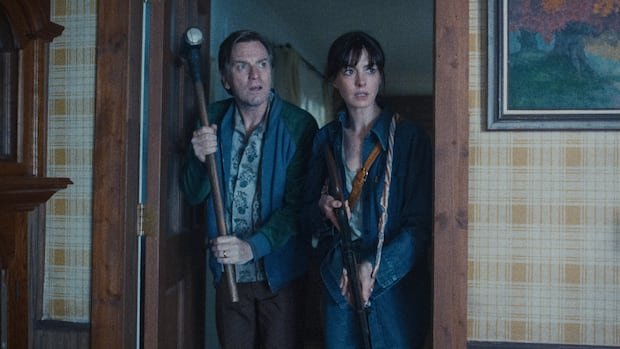

In 1982, the primary concerns of a housewife might revolve around her children’s activities, her husband’s work commitments, and peculiar occurrences in her neighborhood. Enter the realm of Oak Street, where Denise, portrayed by Anne Hathaway, and filmmaker David Robert Mitchell introduce “The End of Oak Street.” This narrative unfolds as a family grapples with their relocation to the late Jurassic era, navigating encounters with strange creatures and internal conflicts.
The cast includes the aloof yet caring father Greg (played by Ewan McGregor), the brilliant but despondent elder sister Audrey (Maisy Stella), and the friendly younger brother Brian (Christian Convery). This Detroit family embodies a quintessential middle-American charm reminiscent of classic family-oriented TV shows.
While “Oak Street” successfully captures a Spielbergian essence blended with Stephen King’s storytelling, it falls short of achieving its touted blockbuster status. Critics point out that the film, despite its nostalgic 80s ambiance, lacks the depth and thematic coherence found in its inspirations.
The movie’s narrative flounders as it struggles to balance character development with dinosaur encounters. The fleeting glimpses into the characters’ personal struggles are overshadowed by repetitive action sequences and lackluster visual storytelling. Despite its potential, “The End of Oak Street” fails to resonate with audiences beyond its surface-level homage to iconic cinematic styles.
As the storyline meanders through chaotic dinosaur attacks and unresolved character arcs, viewers may find themselves yearning for a more cohesive and meaningful plot. While the film’s spectacle of giant lizards and perilous situations offers entertainment value, its lack of substance leaves a void where emotional depth and thematic exploration should reside.
Drawing comparisons to past works like “The Drifting Classroom” and “Testament,” which delved deeper into societal fears and personal dilemmas, “Oak Street” falls short in delivering a resonant message or compelling character arcs. Despite its visual allure and nostalgic nods to Spielberg’s filmography, the film ultimately struggles to leave a lasting impact on its audience.
In the end, “The End of Oak Street” serves as a cautionary tale of style over substance, emphasizing the importance of narrative cohesion and character development in crafting a memorable cinematic experience. While the film may appeal to those seeking a nostalgic thrill, its lack of thematic depth raises questions about the future of storytelling in an increasingly visual-driven industry.