
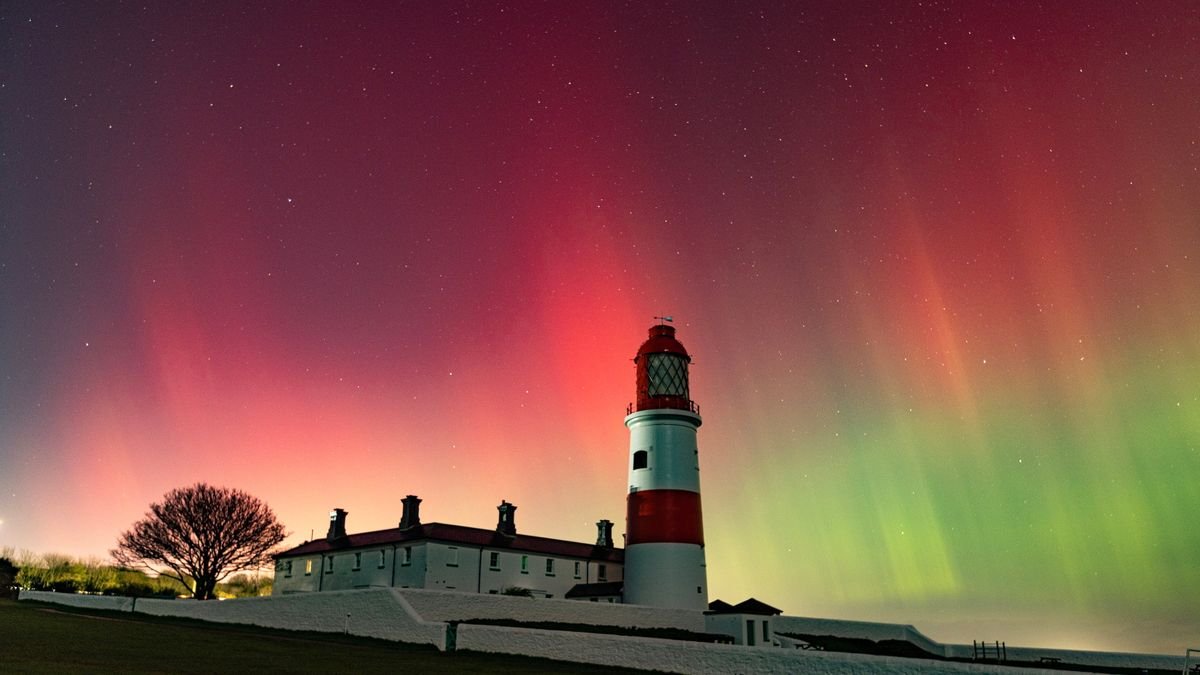

Britons are advised to keep an eye out as certain regions of the United Kingdom might witness the captivating Northern Lights phenomenon today and tomorrow.
The UK’s Met Office has reported that a significant solar flare is en route to Earth, carrying charged particles that could illuminate the night sky in a potentially stunning spectacle. This solar flare, identified as a coronal mass ejection (CME), has the potential to bring the Aurora Borealis to northern parts of Britain, with a chance for those in the south to witness the spectacle as well.
The timing of the CME’s arrival is uncertain, but the Met Office suggests that sightings of the aurora could occur in northern regions of Britain and possibly extend to southern areas depending on cloud coverage.
A rapid coronal mass ejection, a substantial release of charged material from the Sun, departed from the Sun recently and is projected to reach Earth either overnight on Monday or in the morning on Tuesday.
This event could result in the appearance of the Northern Lights in the skies of the UK, particularly over Scotland, Northern Ireland, northern England, and potentially even further south, though visibility will be contingent on when it arrives and the cloud conditions.
Krista Hammond, the Met Office Space Weather Manager, mentioned, “There is still some uncertainty regarding the exact timing of the CME’s arrival, but it is anticipated later tonight or tomorrow morning. The CME is likely to cause geomagnetic storming, providing an opportunity to view the aurora.”
“However, sightings depend on the CME reaching during nighttime hours and clear skies. Unfortunately, Tuesday evening’s cloud and rain may obstruct viewing, even if the timing is favorable.”
Present weather maps indicate heavy cloud cover over the UK from Monday night into Tuesday morning, diminishing the chances for people to witness the Northern Lights.
According to the Met Office’s space weather forecast, a Coronal Mass Ejection (CME) is predicted to arrive late on January 19 or early on January 20 (UTC). Moderate to strong storms are expected, with a possibility of severe storm intervals.
This occurrence is likely to bring the aurora to Scotland, Northern Ireland, northern England, and potentially further south, although visibility hinges on the timing of its arrival and cloud cover.
The Met Office suggests that the thinnest cloud cover is anticipated around 4 am on Tuesday, making it the optimal time to attempt viewing the celestial display.
To catch a glimpse of the aurora, the Met Office advises finding a dark spot with minimal light pollution, gazing towards the northern horizon, and selecting a time when cloud cover is at its thinnest.