
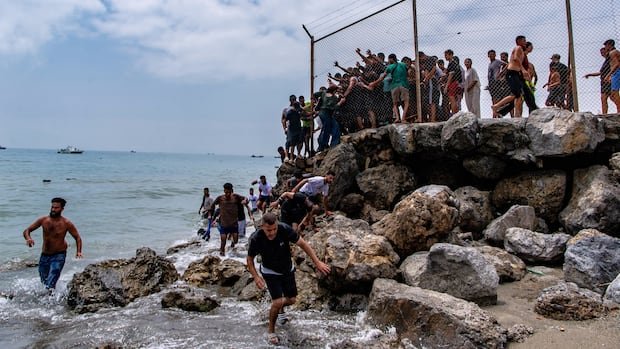

The situation has been described by authorities as chaotic, unsustainable, and a breach of regulations.
A tragic incident unfolded as at least 57 individuals lost their lives following a massive influx of migrants into Spain’s Ceuta from Morocco, causing a stir and discord in Europe.
Approximately 60,000 people entered the Spanish enclave in North Africa on Thursday, with around 48,300 returning to Morocco by Friday evening.
The migrants used various means to reach Ceuta, including swimming from the Moroccan town of Fnideq or attempting to cross from the nearby town of Belyounech, which is a shorter route.
Individuals who managed to cross included children and unaccompanied minors, raising concerns about the dangers of involving minors in irregular migration journeys.
Spanish authorities reported the recovery of 57 bodies on their side of the border, with the possibility of additional casualties on the Moroccan side, including individuals who drowned or were crushed while trying to climb the breakwater.
One Moroccan, identified only as Abdelhakim, shared his harrowing experience of witnessing fatalities during his attempt to cross the Morocco-Spain border.
Ceuta and Melilla, two autonomous cities belonging to Spain and situated at the northern Mediterranean coast of Africa, serve as the only land borders between the European Union and Africa.
These territories have seen periodic spikes in migrant crossings, but the scale of Thursday’s events appeared unprecedented.
Ceuta, an 18.5-square-kilometre peninsula separated from mainland Spain by the Strait of Gibraltar, witnessed a surge in population to 83,000 when 60,000 individuals crossed the border.
The territories of Ceuta and Melilla are coveted by migrants seeking improved economic prospects or refuge from turmoil in their home countries.
Various factors, including recent legal rulings and political tensions, likely contributed to the sudden surge in migrant activity at the border.
In response to the crisis, Spain deployed military forces to restore order in Ceuta and expedite the expulsion of illegal entrants.
The Moroccan side of the border also witnessed security measures to prevent further breaches, with clashes between migrants and authorities in Melilla.
Following the chaotic events, many migrants sought to return to Morocco due to lack of basic necessities and shelter in Ceuta.
Reports indicated that some returnees faced dire conditions, prompting a reconsideration of their migration attempts.
Despite these challenges, some migrants persisted in their efforts to enter Ceuta by alternate means, highlighting the complexities and uncertainties surrounding migration in the region.