
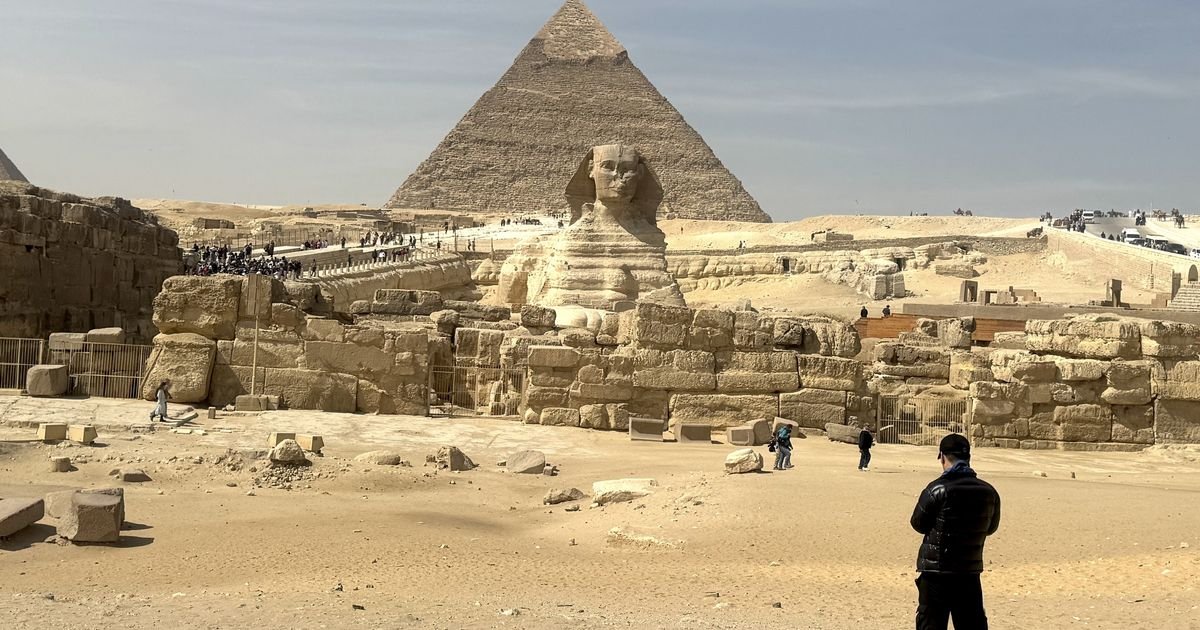

Archaeologists have uncovered enigmatic structures near the Great Pyramid of Giza. The L-shaped feature adjacent to the ancient monument dates back to the era of the ancient royal tombs, with a significant discovery lying beneath it.
A team comprising researchers from Japan and Egypt utilized non-invasive technology to map Giza’s Western Cemetery, revealing two anomalies: an L-shaped structure approximately two meters below the surface and a larger, deeper zone directly underneath it.
The Western Cemetery served as the burial ground for King Khufu’s relatives and high-ranking officials over 4,500 years ago. Recently unveiled between 2021 and 2023, the findings have been detailed in the Archaeological Prospection journal.
The shallow structure, measuring a minimum of 10 meters in length, appears to have been filled with sand post-construction, as reported by the team.
The deeper anomaly displays high resistance, indicating compacted sand and gravel or a potential void, hinting at the presence of walls, shafts, or a chamber.
Lead researcher Motoyuki Sato from Tohoku University expressed confidence that the distinct geometry rules out natural formation, emphasizing the need for further investigation to confirm the anomalies’ nature.
The study proposes that the anomalies might signify vertical limestone walls or shafts linked to a tomb, underscoring the necessity for additional research.
While not directly involved in the project, Harvard Egyptologist Peter Der Manuelian found the location intriguing due to the unexplored section within the cemetery, highlighting the significance of this discovery for future exploration.
Excavations are currently in progress to validate the scan results, with Sato leading the efforts.
Unveiling a new burial or chamber through these structures could revolutionize the understanding of how King Khufu’s family and elite individuals were interred at the Giza Plateau.