
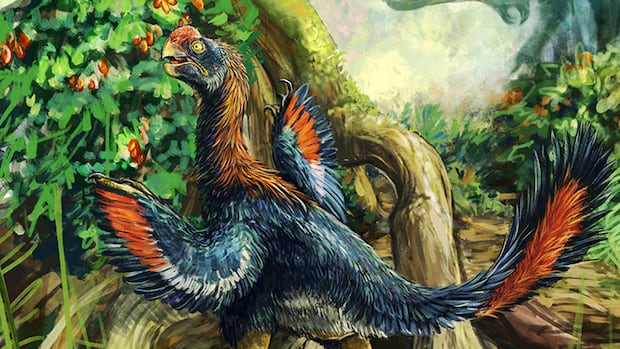

While various dinosaurs were using their robust teeth to crush bones of their meals or leisurely munching on foliage, Infernogallus jamesi might have been enjoying nature’s sugary offerings.
This newly identified species, whose name means “hell chicken,” possessed a beak devoid of teeth and a jaw structure that strongly indicates a diet primarily consisting of fruit, as outlined in a study published in Nature Communications.
Paleontologist Greg Funston, the study’s lead author, remarked to As It Happens host Nil Köksal, “This dinosaur came as a bit of a surprise, as we had long assumed that dinosaurs did not consume fruit.”
If the findings are validated, this would mark the hell chicken as the first recognized frugivore dinosaur, although some researchers caution that further evidence is necessary to substantiate this theory.
“Likely quite fierce”
Infernogallus jamesi was a dinosaur comparable in size to a turkey, existing approximately 66 million years ago, cohabiting the Earth with the likes of Tyrannosaurus rex and Triceratops.
Belonging to the Caenagnathid family, which includes bird-like dinosaurs featuring elongated beaks and feathered bodies, Funston characterized it as a blend between an emu and a parrot, suggesting it was “probably quite fierce in nature.”
“Most individuals wouldn’t want to be trapped in a cage with a turkey,” remarked Funston, an assistant professor at Stony Brook University in New York. “However, the name isn’t derived from its temperament or unruly behavior.”

The name of the hell chicken, rather, is derived from the Hell Creek Formation, where its fossil was unearthed in 2011. This region is now a rocky landscape that covers much of the western United States and parts of Canada. However, during the Cretaceous period, it featured a vibrant forest teeming with ancient wildlife.
The discovery is significant as complete Caenagnathid fossils are uncommon, according to paleontologist and author Riley Black, who did not participate in the research.
-
Jerky-like skin of a 52,000-year-old woolly mammoth could change what we know about ancient DNA
-
Prehistoric puke reveals hunting (and hurling) habits of ancient ocean predators
“I have been anticipating a fossil like Infernogallus for quite some time,” said Black in an email.
“Infernogallus offers us our first glimpse into what a caenagnathid skeleton truly looked like in life, and even more intriguingly, it is so unusual that paleontologists may need to reconsider how these dinosaurs lived.”
A beak without teeth and a jaw similar to humans
The peculiarity of the hell chicken’s skeleton, according to Funston, lies in its jaw.
Most dinosaurs, he noted, had jaws that “moved primarily up and down.” This mechanism provided carnivores with the power to consume their prey and enabled herbivores to grind through twigs, leaves, ferns, and branches.
This was not the case for the hell chicken.
“Rather than moving the jaws vertically, these muscles would pull the jaws from front to back. This action is something we are familiar with; it’s akin to our chewing motion,” he explained.
“This creature was processing something relatively soft, but it required considerable manipulation before it could be swallowed. To us, the only thing that seems to fit this description is fruit.”
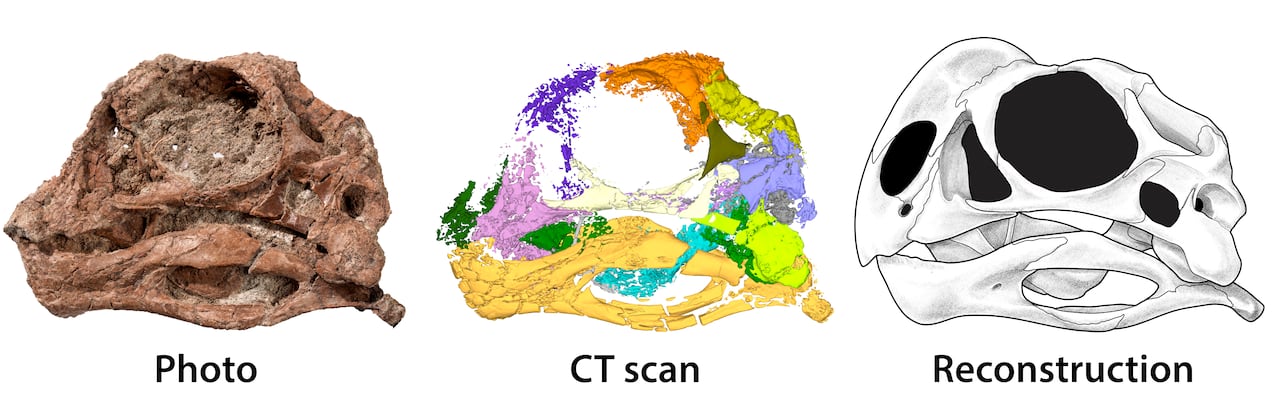
Researchers analyzed, scanned, and reconstructed the skull of Infernogallus jamesi, also known as the ‘hell chicken.’ (Submitted by Greg Funston)
If their hypothesis is accurate, it would clarify a longstanding enigma that has puzzled paleontologists, he notes.
Around 130 million years ago, flowering plants began to emerge on the planet, replacing the previously dominant cone-bearing flora and offering a wealth of fruit for animals to consume.
Birds — which themselves are classified as dinosaurs — were among the first to embrace fruit. Research indicates they have been indulging in nature’s treats for at least 120 million years.
However, up until this point, evidence suggesting that non-avian dinosaurs relied on fruit as a dietary staple was scarce.
“For a long period, we faced challenges in understanding how dinosaur evolution aligned with this significant shift,” Funston stated.
Evidence ‘circumstantial,’ warns researcher
Yet, the evidence supporting the notion that the hell chicken specialized in fruit consumption remains “circumstantial at this time,” cautions Black.
“When examining dinosaur skeletons, there’s always a conflict between what a dinosaur might have done and what it genuinely did,” she explained.
“The beaky structure of Infernogallus and its size strongly suggest that this dinosaur was picking small food items and consuming relatively soft substances. But what exactly?”
To establish certainty, she notes, scientists would need to unearth direct evidence of fruit within the preserved remains of the creature’s digestive system — a task easier said than done. It would require a hell chicken to die shortly after feeding, become fossilized, and then be discovered in a relatively intact condition.
“Such discoveries are quite rare, often needing exceptional conditions and a bit of luck,” she added. “The fact that we have any gut contents from any dinosaurs is truly fortunate.”
-
Researchers discover thousands of dinosaur footprints in Alaska
-
Scientists digitally rebuilt the brain of a 205M year-old dinosaur. Here’s what they found
Nevertheless, she asserts that the study marks an exciting initial step.
“This research will certainly inspire further exploration and analysis regarding the interactions between plants and dinosaurs,” she stated.
“In paleontology, few findings ever provide a conclusive understanding of how an organism that has been extinct for millions of years truly lived. It is the queries that drive our investigations and discussions, which is part of what makes this field so fascinating.”