
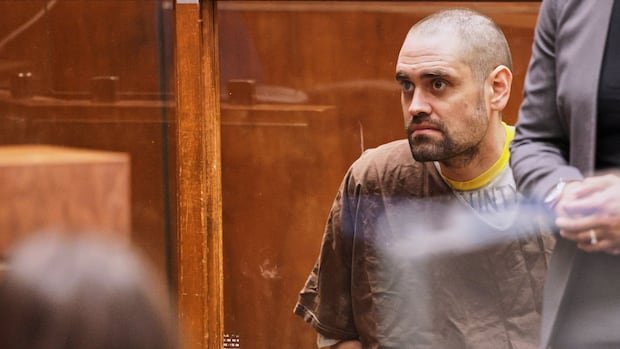

Nick Reiner, facing allegations of murdering his parents, Rob Reiner and Michele Singer Reiner, has been refused access to a $1.5-million US trust fund he was attempting to utilize for his legal defense. As revealed in a June submission, Reiner was pursuing purportedly unpaid funds from a trust his parents set up for him in 1993.
According to court documents acquired by CBC News, trustees turned down Reiner’s request for the funds, invoking a section of California law referred to as the “slayer statute,” which bars individuals from inheriting money, assets, or trusts from someone they have knowingly and unlawfully killed.
Rob Reiner, a renowned filmmaker and actor, and his wife, Michele, a photographer and producer, were fatally stabbed in their California residence on December 14, 2025. Shortly after, their son Nick Reiner was taken into custody. The 32-year-old was formally charged with murder on July 20, and he has pleaded not guilty.
An indictment from a Los Angeles County grand jury, disclosed last Wednesday, alleges that Reiner laid in wait before assaulting his parents. This, along with other circumstances, raises the possibility of him facing the death penalty. District Attorney Nathan Hochman has stated that a decision on seeking the death penalty has not yet been made.
Reiner is set to appear in court for a pretrial hearing in September, currently being represented by public defender Kimberly Greene, who CBC News has reached out to for comment.
The June filing mentioned that aside from the main family trust fund, individual smaller trust funds were created for the Reiner children, with Nick Reiner entitled to a portion at the age of 30 and the remainder at 35. However, he alleged in the petition that he had not received the funds due to him at 30, claiming the trustees were withholding funds rightfully belonging to him.
The petition highlighted that the fund’s assets amounted to at least $1.5 million US. Although high-profile attorney Alan Jackson was initially retained to represent Reiner, he departed within a month without disclosing the reason. It was later revealed in the June filing that Reiner’s siblings, Jake and Romy Reiner, initially agreed to cover their brother’s legal expenses before reversing their decision.
In a statement accompanying the petition, Jackson expressed willingness to rejoin the case if the funds became available to hire him. The siblings have refrained from making public statements regarding the legal proceedings.
The attorney overseeing the trust fund, Paul R. Kanin, and incoming trustee Jodi Pais Montgomery concluded in court records that until the outcome of Reiner’s criminal case is determined, funds cannot be disbursed. The filing emphasized that access to the trust fund hinges on clarifying the impact of Probate Code Section 250 and related “slayer statute” principles on Reiner’s entitlement.
As many details remain undisclosed to the public eight months after the tragedy, authorities have refrained from speculating on motives. Jake Reiner, the Reiners’ eldest son, shared in April about enduring the harrowing experience of his parents’ murder and the subsequent focus on allegations concerning his brother.
Rob Reiner, recognized for his extensive contributions to the film industry, both as an actor and director of iconic films like “The Princess Bride,” “A Few Good Men,” and “Stand By Me,” met his wife, Michele, during the filming of the beloved romantic comedy “When Harry Met Sally.” Their marriage lasted 36 years.
The Substack essay by Jake Reiner reflected on the profound loss of both parents simultaneously, emphasizing their undeserved fate.