
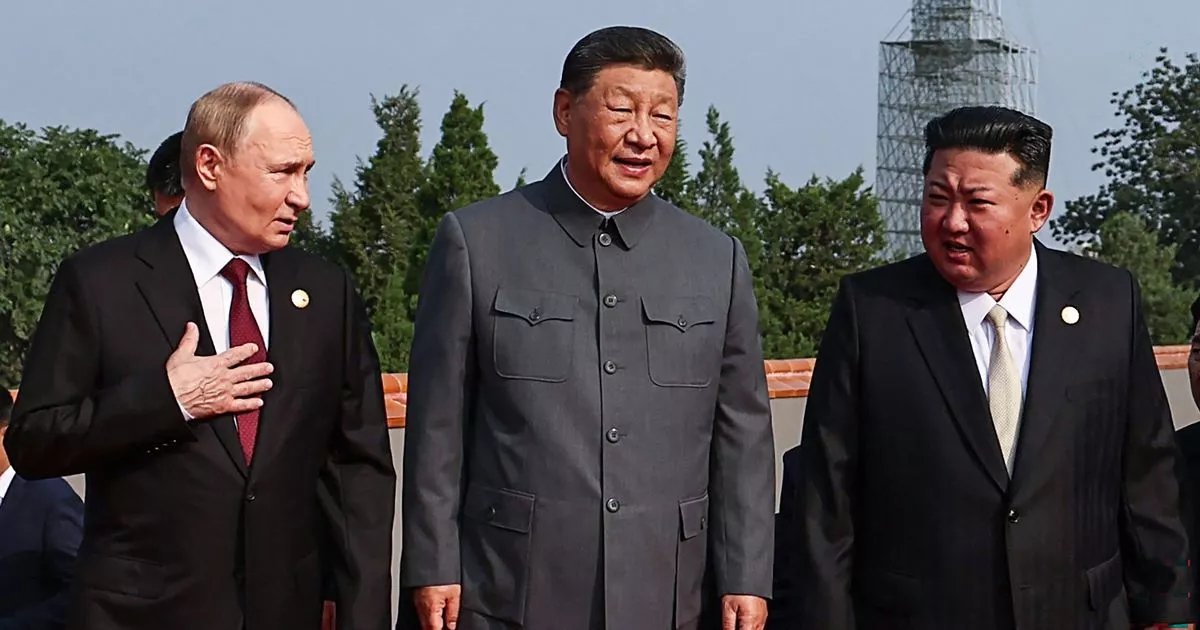

China’s recent military parade went beyond honoring its sacrifices in World War II. The display featured precise marching, impressive weaponry such as missiles and new armaments, showcasing the nation’s military might.
The parade also conveyed a message of solidarity among leaders like Kim Jong-un of North Korea and Vladimir Putin of Russia. This demonstration was interpreted by many as a direct challenge to the United States, particularly in response to economic pressures under President Donald Trump.
The warm interaction between Putin and Xi Jinping, with Putin referring to Xi as a “dear friend,” highlighted the strengthening ties between China and Russia, aiming to assert their global influence. This gesture was perceived as a deliberate attempt to undermine the US and elevate the status of China, Russia, and their allies.
The joint presence of Xi, Putin, and Kim at the ceremony underscored their growing alignment and China’s bid for leadership in the region. The event symbolized China’s determination to assert its dominance in both military and economic spheres, with Russia and North Korea aligning closely with China’s strategic objectives.
The conspicuous absence of Trump at the event did not go unnoticed, with his reactions on social media reflecting a sense of jealousy and anger towards the gathering of rival leaders. The meeting was seen as a strategic move to challenge US dominance and promote the collective strength of China, Russia, and North Korea.
Xi’s declaration emphasized China’s commitment to peace but also issued a veiled warning to potential adversaries, particularly the US and its allies. The historical context of China’s sacrifices in World War II was invoked to underscore the nation’s resolve and readiness to defend its interests, including the possible reunification with Taiwan.
While Kim Jong-un’s presence added a dynamic element to the event, Putin emerged as a central figure, leveraging his relationship with China for economic and military advantages. This strategic alignment with China allowed Putin to bolster his domestic image while pursuing his geopolitical objectives in conflicts like Ukraine.
Overall, the event signaled a shift in global power dynamics, with China asserting its ambitions to challenge the US both militarily and economically in the near future. The display of unity among China, Russia, and North Korea showcased a potential realignment of power structures that could impact international relations significantly.