
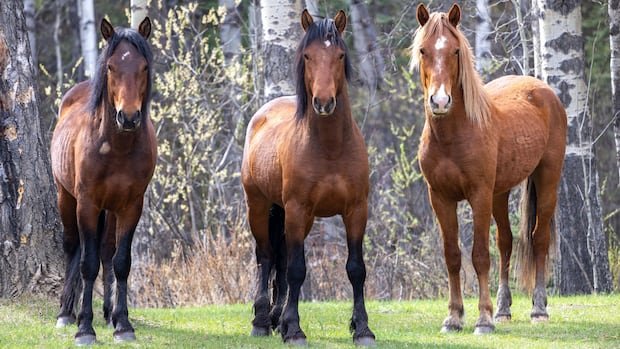

Health Canada has greenlit the testing of a birth control vaccine on free-roaming horses in Alberta, as reported by the provincial government. The move comes as horse populations in certain areas of Alberta have surged to concerning levels, prompting the need for measures to prevent excessive impact on grazing lands for livestock and wildlife.
Among the strategies outlined in Alberta’s feral horse management framework are contraception, removal from the wild, and adoption programs to manage the horse population. In late August, Health Canada granted a “research authorization” for the use of the contraceptive vaccine SpayVac-Equid on feral horses in Alberta.
While the approval for general use is pending, the Alberta government is currently reviewing the specifics of the contraception authorization. The province aims to implement management actions in a humane and science-based manner, focusing on data collection and adoption initiatives.
A recent feral horse survey revealed a record-high count of 2,072 wild horses across Alberta’s equine management zones, with population levels in certain zones deemed unsustainable. The Alberta government classifies these horses as stray animals rather than wildlife.
In a bid to address the population issue, a new contraception pilot project is set to be launched by the Wild Horses of Alberta Society and the provincial government. This initiative will involve capturing horses, administering the vaccine manually, and releasing them back into the wild. The vaccine is designed to prevent conception for several years without altering herd dynamics, offering a promising alternative to previous costly and logistically challenging methods.
The project, expected to kick off this fall, will also involve capturing a limited number of young stallions for removal from the wild. The overarching goal is to maintain a balance between managing horse populations and keeping stakeholders satisfied, according to Jack Nichol, the president of the Wild Horses of Alberta Society. The society, established in 2002, focuses on rescuing, rehabilitating, and rehoming horses that stray onto private properties.