
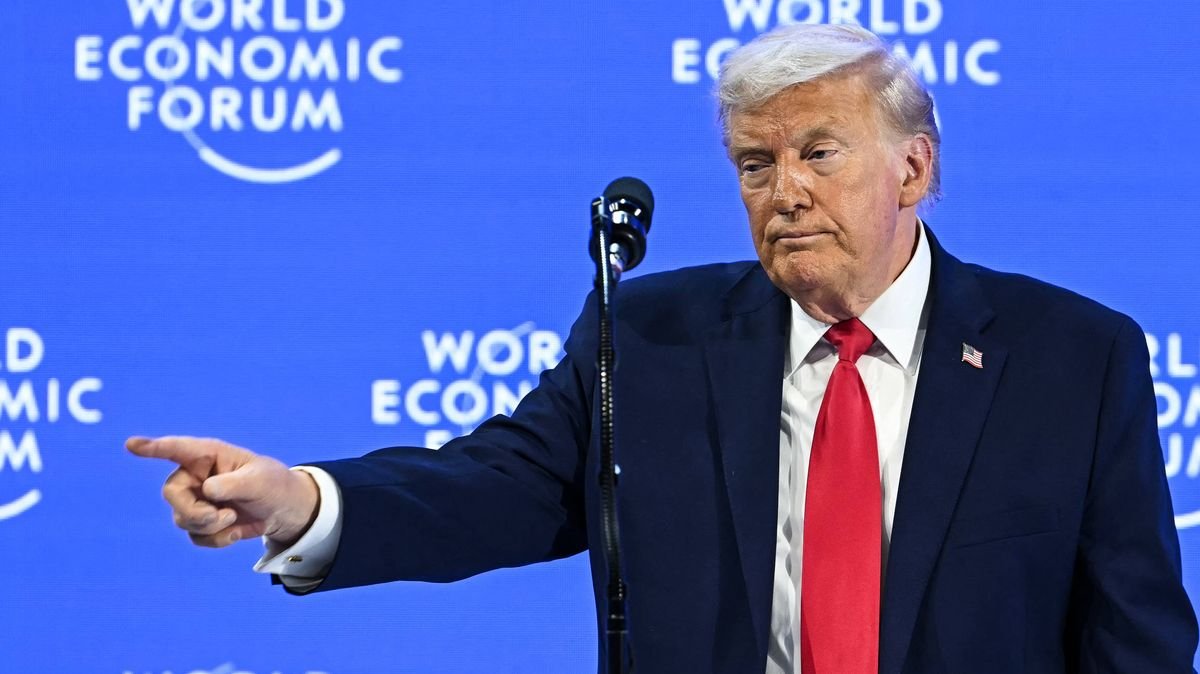

Donald Trump’s appearance at the Davos summit was anticipated as a chance for the US President to provide reassurance to a concerned global audience.
However, the event turned into a display of self-importance, inconsistency, and a lack of understanding of global affairs, highlighting the risky nature of his worldview. Addressing world leaders at the World Economic Forum, Trump did not focus on foreign policy but rather engaged in a performance tailored to his loyal supporters and an imaginary audience that idolizes, fears, and obeys him endlessly.
The actual content of his speech was overshadowed by the negative impact it had. It showcased a president who confuses bravado with leadership, confidence with strategy, and inconsistency with strength. It was essentially a parody of geopolitics. This was evident in Trump’s peculiar fixation on Greenland, treating it as if it were a struggling golf resort he could purchase at an auction, envisioning branding it with the Trump logo.
To stay updated on the latest developments related to Trump, visit our dedicated page on the President and learn about his remarks on the tragic ICE shooting.
During his Davos speech, Trump emphasized the need for America to assert “right title and ownership” over Greenland to protect it, as if sovereignty could be obtained like a purchase receipt. While this might sound comical, like a wealthy landlord eyeing a massive island as distressed property, the implications are serious.
Greenland holds significance due to its strategic location between North America and Europe. With the melting of Arctic ice, new shipping routes are opening up, increasing the region’s military and economic importance. The US already operates the crucial Pituffik Space Base on the island, which provides missile warnings and surveillance in the North Atlantic.
In addition to its strategic value, Greenland also possesses rare-earth minerals essential for modern economies and defense systems. Various nations, including China, Europe, and Britain, recognize this importance. However, ownership has never been a prerequisite. Trump fails to distinguish between exerting influence and outright possession. He is disinterested in collaboration and nuanced partnerships, preferring control at all costs. His perspective is more akin to that of a real estate developer inspecting a showroom, impatiently waiting for the keys to be handed over.
For Europe, Trump’s rhetoric raises genuine concerns. Greenland is an autonomous territory under the Kingdom of Denmark, a NATO ally. Trump’s casual talk of acquiring the island, criticizing Denmark’s defense spending, and hinting at economic repercussions crosses a fundamental boundary. Treating borders as negotiable and sovereignty as dispensable jeopardizes the post-World War II order. This explains the European leaders’ visible disdain towards Trump’s actions, not out of anti-American sentiment but out of genuine alarm.
Trump’s confusion between Greenland and Iceland, his contradictory statements about the use of force, and his reduction of territorial acquisition to a casual request for “a piece of ice” only add to the absurdity of the situation. His smug delivery of these inconsistencies reflects a man who believes confidence can compensate for lack of coherence.
American involvement in Greenland can have positive aspects, aiding in securing the region and potentially countering Chinese influence while supporting Greenland’s development. However, there is a significant difference between partnership and coercion. Trump’s approach leans towards the latter, masked as leadership but resembling a bullying tactic disguised as diplomacy.
Despite Trump’s initial bluster, the situation quickly shifted after his Davos performance. Talks emerged, a “framework” was mentioned, and threats of imposing tariffs on European allies dissipated. Trump claimed productive discussions with NATO on social media, hinting at a forthcoming deal concerning Greenland and the Arctic. However, the diplomatic reality does not align with Trump’s claims. There is no agreement for US ownership, no transfer of sovereignty, and no indication of an Arctic land grab. The so-called “framework” appears more like a retreat hastily packaged as a triumph.
While Trump sought validation for his actions at Davos, the most significant intervention came from Mark Carney, who highlighted a growing consensus among leaders regarding the fractured US-led global order and the diminishing trust in American leadership under Trump. Carney emphasized the necessity for more multilateralism and less reliance on an unpredictable America. This sentiment resonates strongly with the UK, a NATO member and close US ally, emphasizing the importance of stability, adherence to rules, and trust.
Trump’s handling of the Greenland issue undermines these principles. By treating alliances as optional, disregarding international law, and prioritizing personal entitlement over established norms, Trump’s actions