
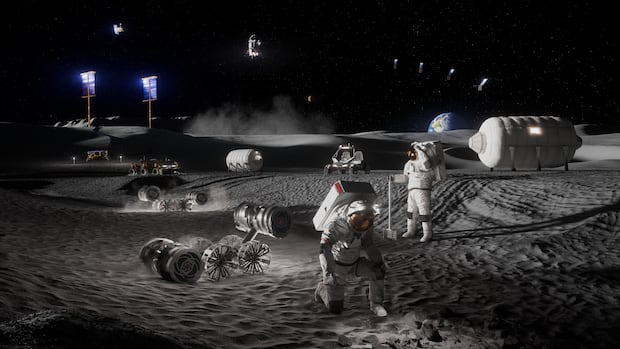

Humans have envisioned the possibility of venturing into space for a long time. Frequently, science fiction depicts bustling cities on the barren landscapes of the Moon and Mars.
According to some wealthy visionaries like Elon Musk and Jeff Bezos, lunar cities might soon become a reality.
In fact, SpaceX’s CEO Musk announced on social media in February that the company is redirecting its efforts from Mars colonization — a goal Musk has been passionate about for over a decade.
“For those who might not be aware, SpaceX has already begun concentrating on constructing a self-sustaining city on the Moon, as we can realistically accomplish that in under 10 years, while Mars would take over 20 years,” he stated.
This comment — along with assertions from Blue Origin’s CEO Bezos, who has speculated that “millions of people” could reside in space by 2045 — caught the interest of Martin Elvis, a senior astrophysicist at Harvard University’s Smithsonian Astrophysical Observatory.
Together with Jonathan McDowell, an astrophysicist and honorary professor at the Durham University Space Research Centre in the UK, they decided to analyze the data.
However, their research revealed that the prospects for a lunar community are not as promising as one might hope, so don’t start packing your bags yet.
In their study published in the journal Frontiers in Space Technologies, they examined the energy and water requirements necessary to support human life on the Moon.
Regarding energy, they concluded that solar and nuclear sources would suffice for sustaining a population of one million on the lunar surface.
However, the issue of water arises.
Contrary to what some might think, there is indeed water on the Moon, predominantly located in permanently shadowed regions (PSRs) at the poles, which never receive sunlight.
Yet, their findings indicate that the lunar water supply is inadequate to support a large human settlement.
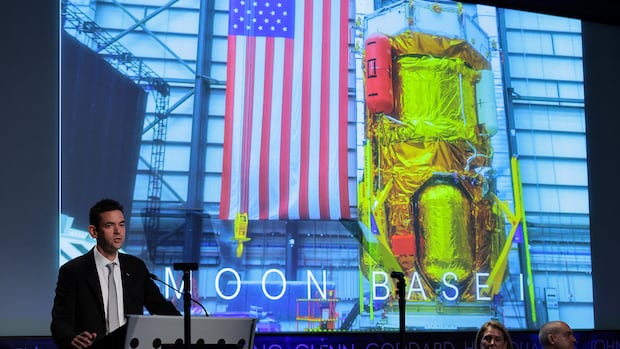
NASA has outlined its plans to build a base on the moon that will first be occupied by rovers and drones, but the longer-term goal is human habitation.
“Our research indicates that while it is feasible to establish an Antarctic-style base on the Moon for centuries, creating extensive cities akin to those in top science fiction requires finding a sustainable water source, which is currently lacking,” McDowell elaborated.
Assuming the Moon harbors approximately one billion tonnes of water, which aligns with existing estimates, they concluded that a population of one million could only survive for about a century, provided that 98 percent of the water is recycled, similar to practices on the International Space Station.
‘A small lake’
Elvis remarked that while a billion tonnes of water may sound significant, it is essential to put that into context.
“If you had an enormous aquarium the size of Central Park in Manhattan, you could fill it just enough to submerge the Statue of Liberty, and that represents the total water available. So, while it seems large, it’s essentially a small lake, and a small lake won’t sustain a large city for an extended period,” he added.
That said, this doesn’t imply that human habitation on the Moon is impossible. If the population were to be limited to 10,000, they found that could be sustained for centuries.
However, this is based on the assumption that the estimate of one billion tonnes of water is accurate.
“It’s very likely that a billion tonnes is a significant overestimate. It might actually be 20 to 30 times too high,” Elvis cautioned.
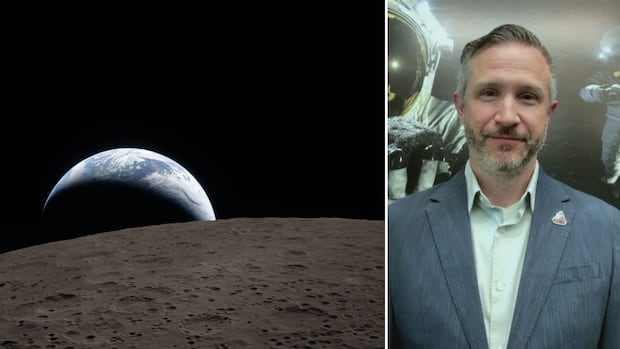
Jacob Bleacher, NASA’s chief exploration scientist, says the first two Artemis missions have set the stage for the next moon landing, a moon base and eventually, human exploration of Mars, missions so challenging that only international co-operation makes them possible.
He also indicated that fully recovering all available water is unlikely. Instead, it would be more realistic to extract only one-third to half of what exists.
“My best estimation is that the actual accessible water may only be one percent of previous estimates, which means instead of sustaining life for 100 years, it may only last for one year,” he remarked.
Additionally, there’s still uncertainty regarding the form this water takes, and it’s crucial to clarify that aspect.
-
We’ve already been to the moon, so why are we going again?
-
NASA has set its sights on a moon base. Here’s how Canada can play an important role
“While it’s one thing to detect water from satellites, uncertainties remain in those measurements,” explained Gordon Osinski, a professor of planetary geology at Western University in London, Ontario.
“I believe it exists, but we need to conduct ground verification to confirm its presence. Moreover, there are greater unknowns regarding its form… Is it akin to permafrost in the Arctic, which consists of soil embedded with tiny ice crystals, making it difficult to extract?”
Although this may seem like discouraging news for humanity’s aspirations to explore the universe, McDowell emphasized the importance of understanding the reality of the situation.
“The truth is never negative,” he stated. “What’s truly negative is embarking on a venture that is destined for failure.”