
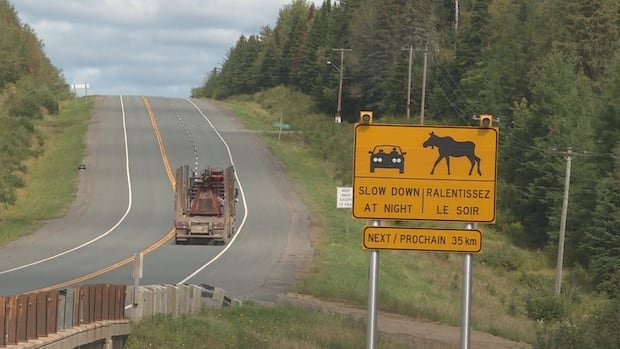

On a late August Saturday night, the Chaleur Lightning hockey team finished an exhibition game against the Miramichi Timberwolves and got on their team bus to return to Bathurst. Assistant coach Alex Ouellet recalled hearing a gasp from the driver shortly into the journey. A collision occurred as the bus encountered a moose on the highway, fortunately resulting in no injuries for the team and coaches, except for minor scratches on the driver.
The incident left a lasting impression on Ouellet and the team, similar to many others in New Brunswick who have faced encounters with large wildlife. The following week, the province announced the addition of two new wildlife crossings along the same highway stretch where the accident happened.
Wildlife mitigation measures in New Brunswick include wildlife fencing and crossings or tunnels. Transportation Minister Chuck Chiasson explained that the placement of these measures is determined by collision data to address high-risk areas. Currently, 331 kilometers of New Brunswick highways are fenced on both sides to prevent wildlife incidents.
New Brunswick boasts 82 wildlife crossings, such as concrete tunnels under highways, with two recently constructed on Route 8 between Miramichi and Bathurst. These tunnels are spacious, measuring over four meters tall and wide, allowing various wildlife to safely pass through.
Wildlife ecologist Graham Forbes noted that animals quickly adapt to these tunnels, utilizing them for safe passage. The tunnels are designed to guide animals towards the underpass, making it intuitive for them to navigate.
Apart from large mammals like moose, the tunnels are also frequented by other wildlife species, showcasing their effectiveness in providing safe passage. Despite the presence of wildlife crossings, the Department of Transportation has not observed a significant decrease in collisions. Chiasson emphasized the department’s commitment to enhancing safety measures and addressing collision hotspots.
Ouellet expressed hope for additional fencing in the area but acknowledged the challenges in entirely preventing wildlife collisions. He stressed the importance of implementing preventive measures to mitigate risks on the road.