
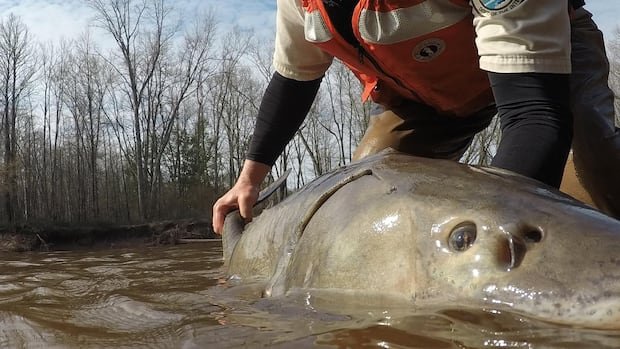

Lake sturgeon in the Great Lakes could potentially live for more than 400 years, according to a recent study. These ancient-looking fish, known for their armored appearance, have faced significant challenges, with overfishing and habitat destruction leading to a drastic decline in their population.
Research spanning over four decades and analyzing data from captured and recaptured sturgeon across the Great Lakes revealed surprising findings. Traditional estimates pegged the lifespan of lake sturgeon at around 150 years. However, using a new approach, researchers found that some sturgeon could be much older than previously believed.
The study, led by Ed Baker, a fisheries scientist from the Michigan Department of Natural Resources, challenged the conventional method of age estimation based on growth rings. By examining the growth rates of individual sturgeon over time, researchers were able to project potential lifespans reaching into centuries.
The discovery has significant implications for conservation efforts, especially for Trevor Pitcher, a biologist at the University of Windsor. He emphasized the need to rethink conservation strategies for a species that could live for centuries. Pitcher highlighted the importance of sturgeon in the ecosystem, noting their role in controlling invasive species like quagga mussels and gobies.
The study underscores the critical role humans play in the recovery of lake sturgeon populations. Efforts such as raising and releasing young sturgeon into the wild have become essential for the survival of this species. Pitcher’s team is actively involved in training individuals to support sturgeon conservation initiatives across the Great Lakes region.
For Perry McLeod-Shabogesic, an elder from Nipissing First Nation, lake sturgeon hold cultural significance beyond their ecological importance. Considered as “grandfather fish” due to their longevity, sturgeon are revered in Anishinaabe tradition as elders that have witnessed generations of change.
The unique characteristics of sturgeon, as described by McLeod-Shabogesic, place them in a distinct category in the natural world. In Anishinaabe teachings, sturgeon symbolize beings that exist in between, embodying qualities that transcend traditional categorizations.
With the newfound understanding of sturgeon’s potential lifespan, researchers and indigenous communities alike are reevaluating their approach to conservation and acknowledging the enduring importance of these ancient creatures.