
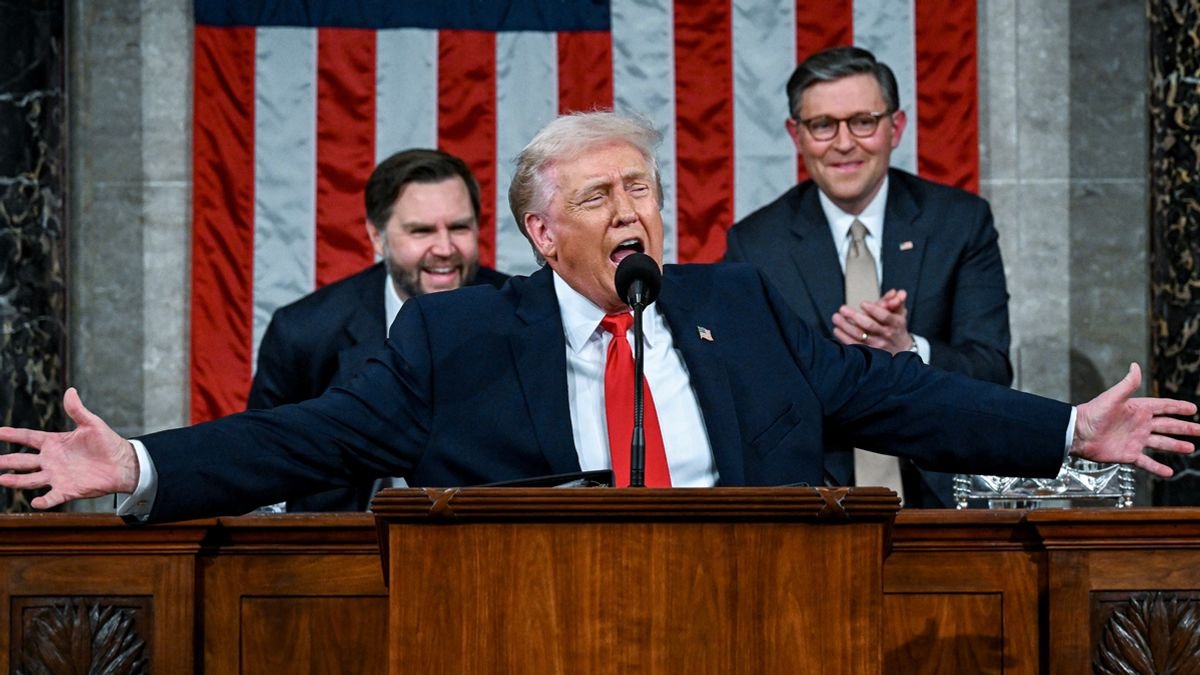

During the State of the Union address, President Donald Trump’s speech seemed more like a contentious debate with reality rather than a check on the nation’s well-being. Throughout the nearly two-hour address to Congress, the president attempted to shape a narrative that skewed towards self-praise, devoid of factual accuracy and contextual relevance to the average American experience.
The audience in the chamber was sharply divided, with Republicans enthusiastically applauding and Democrats appearing stunned and uncertain. The speech unfolded like a familiar routine, featuring a collection of Trump’s well-known talking points, extended to an excessive length with theatrical elements.
The event saw a parade of guests for applause, exploitation of tragedies for political gain, and borrowed heroism that was quickly discarded. Trump, a draft dodger, attempted to bask in the courage of others as if it were his own, leading to moments of discomfort even among his supporters.
Amidst a flurry of falsehoods, Trump painted a rosy picture of America that contradicted reality. Issues such as petrol prices, wages, healthcare, and diplomatic relationships were misrepresented, overshadowed by divisive rhetoric on immigration and voter fraud.
The address lacked substance and failed to sway public opinion, reinforcing Trump’s declining popularity. Instead of offering a vision for the future, the speech highlighted a presidency mired in old grievances and false narratives, signaling a period of stagnation rather than progress.
As the world watched, the disconnect between Trump’s rhetoric and reality became starkly evident, revealing a leader out of touch with the true state of the nation. The spectacle served as a testament to the president’s mindset – detached, delusional, and out of sync with the world at large.