

In the lobby of a towering building on Fifth Avenue, under a ceiling that gleamed like it had a scheduled sunbathing session, I observed a reality TV personality making a grand entrance into the realm of American politics.
Back in June 2015, few comprehended the menace that Donald Trump represented. It wasn’t just a show, but a deliberate unveiling of a perilous strategy. When he announced his candidacy for the presidency, he depicted migrants as criminals and portrayed grievances as acts of patriotism. It felt like a theatrical performance, almost surreal, as the host of The US Apprentice transitioned into a presidential contender akin to a season finale.
It wasn’t just a spectacle; it marked the beginning of a political offensive, rooted in division, fueled by drama, and aimed at perpetuating confrontation. The repercussions of his actions reverberate across borders and oceans, now reaching places like South East Manchester.
Since that pivotal day, Trump has honed a playbook that reshaped modern populism. He positioned himself as the advocate for the “forgotten” Americans while vilifying courts, journalists, and bureaucrats as corrupt adversaries. His narrative framed a battle between “the people” and an elitist establishment. Immigration transcended from a policy issue to a cultural battleground, with a border wall symbolizing strength and deportations serving as evidence of resolve.
Despite promising to uplift working families, his key legislative accomplishments disproportionately favored corporations and the affluent. While his billionaire associates thrived, many workers struggled to keep up with escalating living costs, assuming they managed to retain their jobs.
Simultaneously, trade disputes were initiated under the guise of safeguarding domestic industries, tariffs were imposed, and international alliances strained in the pursuit of “America First.” Blaming outsiders for setbacks became a norm, with any critique labeled as sabotage. Those pointing out flaws were branded as foes, even targeting judges and Supreme Court justices. Loyalty was prized over expertise, and division became the guiding principle, yielding tangible results.
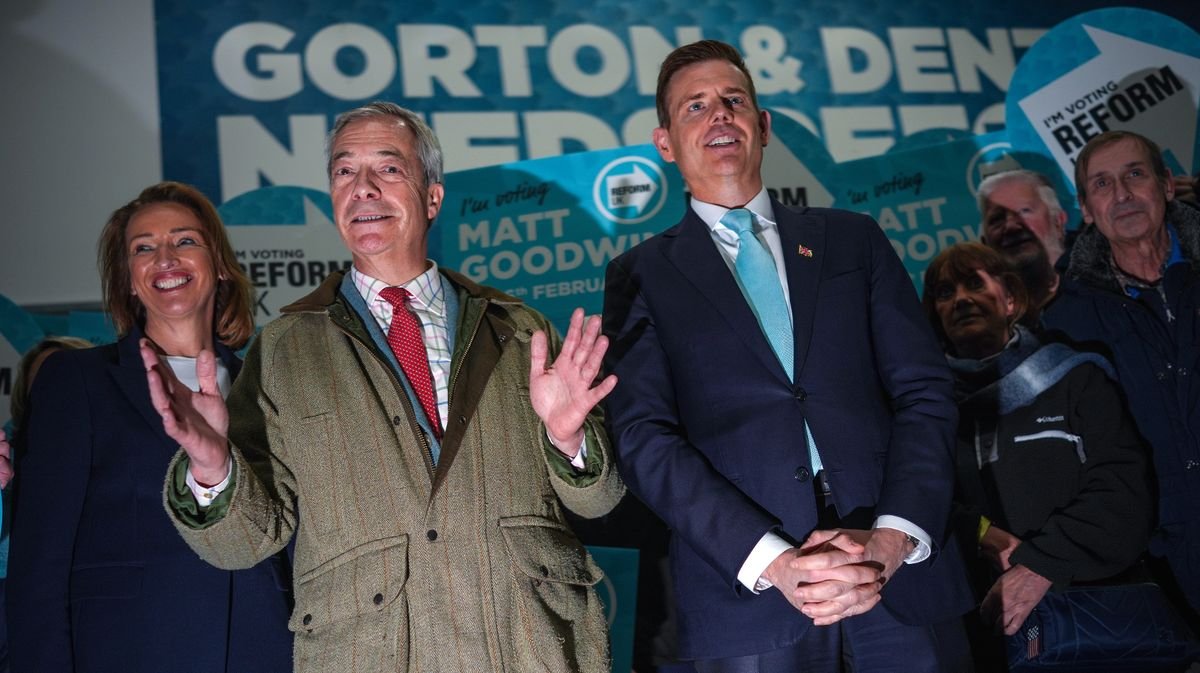
This trend should serve as a warning for every voter in Gorton and Denton. When they cast their votes, they aren’t just selecting between political parties; they are deciding if a similar style of politics, founded on grievances, conflicts, and personalities, gains further ground.
The resemblances between Trump’s tactics and those now endorsed by Nigel Farage and Reform UK are glaring. Farage, an avid admirer of the US president, emulated Trump’s rhetoric and methods, utilizing outrage as a tool for power. His team mirrors this approach, comprising individuals who have shifted their stances and tones to align with his strategies.
The unifying factor among them isn’t detailed policies but the allure of political opportunities, the next platform, the next headline. The parallels in their approaches are hard to overlook.
Farage, a self-professed Trump enthusiast, has long cultivated an outsider image, challenging the Westminster establishment and framing Brexit as a battle for sovereignty against distant bureaucrats. His discourse of betrayal and restoration defines his political persona, even extending to criticizing his own country on foreign soil instead of addressing issues domestically.
Immigration now occupies a central position in Reform UK’s messaging, echoing Trump’s emphasis on drastic migration cuts, stringent border controls, and disengagement from international frameworks as simplistic solutions to intricate problems. In both scenarios, immigration transcends policy to become a symbol of national resolve.
National sovereignty emerges as another shared theme. Trump’s ‘America First’ doctrine prioritized domestic authority over global partnerships, while Farage’s agenda revolves around reclaiming sovereignty from European counterparts. Both express disdain towards international institutions, arguing they disadvantage ordinary citizens.
In trade, Trump’s tariff policies were justified by claiming that globalization harmed American industries. Farage criticized EU trade structures and international agreements, advocating for looser regulations and enhanced national autonomy. Their narrative asserts that global systems have failed their citizens but promises protection through nationalistic policies.
Economically, the similarities deepen. Trump slashed corporate taxes and dismantled environmental and financial safeguards, while Reform UK advocates for reduced taxes and extensive deregulation. Both portray smaller government as synonymous with freedom, benefiting from financial backing rooted in wealth.
Their energy policies align as well, with Trump bolstering fossil fuel production and dismantling environmental protections, while Farage and his cohorts oppose net-zero targets and green levies, arguing they burden households. In their realm, environmental prudence is construed as economic self-harm.
However, the most pressing concern isn’t policy alignment but the tone set by these leaders. Both Trump and Farage excelled at provocation, turning controversy into currency, weaponizing social media, and transforming politics into a spectacle where personality eclipses policy and loyalty outweighs details.
Drawing from the US experience, such an approach left a legacy of deep polarization, eroding institutional trust, hardening communities, and skewing economic policies in favor of the affluent. The US stands divided, evident from Ohio to Orange County, reflecting a fractured society even in mundane settings like suburban dog parks where unity has given way to discord